Also available on:
Episode Description
When a tree has everything it needs to grow, you get champion trees right? Actually, the seedlings at the forest floor of Congaree National Park lack one thing. Sunlight. The dense forest canopy blocks much of it. Once a seedling sprouts, many are consigned to a half grown light. Except for the lucky few that can race for a small patch of sunlight, perhaps one day reaching through the forest canopy. This fierce competition for light is what has grown champion trees at Congaree. Tune in to learn how this park boasts many national champion trees, how it was almost logged not once, but twice and also find out just how hard, a sweetgum tree really is.
Resources & Links
Never Miss an Episode
Get notified when we release new episodes
Join our community of nature lovers and curious kids!
Episode Transcript
National Park Scouts
The Race for Sunlight: Congaree's Champion Trees
Host: Jenni · Topic: Champion trees, forest ecology, Congaree National Park conservation history
Intro
Imagine a flood just came through this forest. The water is starting to pull back, and it leaves behind this thick, dark mud, packed with thousands and thousands of tiny tree seeds, all sprouting at once, all in the exact same patch of ground. And here's the thing about being a baby tree in a crowded forest: there's really only one prize worth having. The treetops above are already so thick and tall, they block almost all the light from ever reaching the ground. So thousands of seedlings start their whole lives in complete shade. Most of them will get stuck down there, a few feet tall, forever in the shade. But a few will win the race. They'll outgrow every single neighbor, break through the treetops, and reach the sun. Today we're talking about champion trees. Let's go.
Welcome to National Park Scouts, the show where curious kids discover America's wildest places. I'm Jenni. Last time, we waded into Congaree's floodplain and found out why this forest floods on purpose - and why that's actually a really good thing. Today we're following that story to its final chapter, because flood-fed soil doesn't just grow ordinary trees. Here, it grows giants. Congaree has more champion trees than anywhere else in North America. We're talking a pine tree taller than a football field stood on one end, a tree with a trunk wider than a school bus is long, and one so tough it could probably shrug off a wrecking ball. Let's go meet the record holders.
Why Congaree grows giants
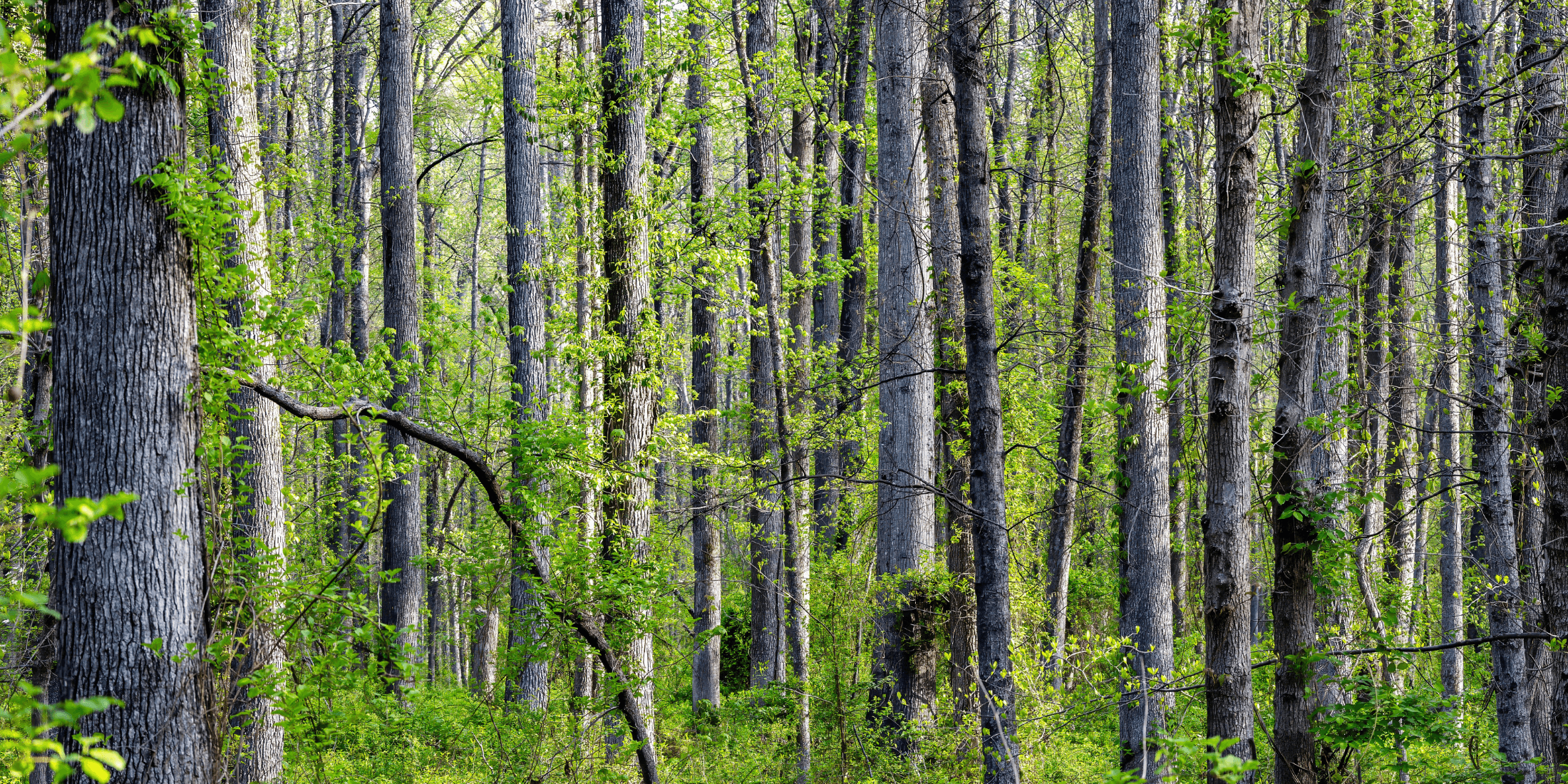
Okay, this next part explains basically everything about why Congaree's trees got so enormous. When the Congaree and Wateree rivers flood, which happens about ten times a year, the water doesn't just cover the ground and leave - it drops off a fresh layer of rich, muddy soil, like the forest getting fed dinner. We talked about that last episode. Here's the part we didn't get to: that rich soil means the ground here can fuel explosive growth. Any seed that lands in it has everything it needs to grow fast. The problem is everything wants the exact same thing. Congaree's canopy, the treetops way up high, is really thick, and it blocks almost all the sunlight from reaching the forest floor. Down on the ground, it's dim and green and quiet, like standing under a giant umbrella.
So think about it from a baby tree's point of view. You've got everything you need in the soil below you, but the one thing you can't live without - sunlight - is a few hundred feet above your head, blocked by a wall of leaves. The only way to win is to grow fast; faster than your neighbors, straight up, racing for that one crack of light before somebody else gets there first. That race, thousands of seedlings all chasing the same patch of sun, is exactly why Congaree's trees don't just grow tall. They grow taller than almost anywhere else in the eastern United States.
The tree Olympics
Believe it or not, there's a real scoring system, like a sport, but for trees. It's run by a group called American Forests, and they've kept track of the country's biggest trees since 1940. To become a champion, a tree gets measured three ways: how big around its trunk is, how tall it is, and how wide its branches spread. Add those numbers together, with a little math trick for the branch part, and you get a total score. Whichever tree of a species scores highest in the whole country becomes the national champion. Basically, it's the Tree Olympics - except instead of running fast or jumping high, the sport is just existing enormously for a very long time.
And Congaree wins that sport more than any other park in North America. Government scientists have counted at least five national champions and 27 state champions growing right here; more than 30 of the biggest trees of their kind in the entire country, all in one forest. So why here? The flood, the fuel, and the fierce competition for light. Keep that going for hundreds of years, and this is exactly what you get: a forest packed with winning trees.
Meet the champions
Alright, let's go meet a few of them.
The loblolly pine
Loblolly - that's such a goofy word to say. Try it: loblolly. It's actually an old word for a mud puddle, because that's exactly where these pines like to grow. This one is a little unusual, because pine trees aren't normally the tallest thing in a swampy hardwood forest like this. But Congaree's champion loblolly pine is 167 feet tall, growing right in the mud. It's one of the tallest trees anywhere in the eastern half of the country.
The bald cypress
Its trunk is over 26 feet around, so that's wider than a school bus is long, wrapped in a circle. And its roots do something really strange: they poke up out of the water in bumpy, woody knobs. They call them knees. Some of these knobs are over seven feet tall.
And here's a really fun part: nobody actually knows why bald cypress trees grow knees. Scientists have guessed for over 200 years. Maybe they help the roots breathe in soggy soil. Maybe they help brace the tree. Maybe they store food. Nobody has proven any of it. It's a real unsolved mystery, standing right there in the swamp, looking like a knobby little army.
The sweet gum
157 feet tall, the second tallest champion in the whole park. You've probably met this tree's seed pods without even knowing it - it has spiky little gumballs that are famous, or maybe infamous, for turning up under a bare foot on a summer sidewalk. Ask a southern kid; they will probably have opinions.
The American elm
135 feet tall. This one doesn't sound as flashy, until you know its backstory. About a hundred years ago, a disease swept across the country and wiped out tens of millions of American elm trees; some people think as many as a hundred million trees gone. Whole streets used to be shaded by giant elms, and they lost every single one. It's pretty sad, isn't it? And it makes Congaree's giant elm pretty special. It's a survivor, one of the lucky ones that never got sick, quietly growing bigger every year while many of its relatives disappeared.
A pine tree in the mud, a tree with a mystery growing out of its roots, gumballs that ambush bare feet, and a lone survivor standing where millions of its cousins didn't make it. That's four champions, and there are dozens more.
Brain break: guess that park sound
Okay, scouts, it's time for our brain break. We're gonna play Guess That Park Sound. Listen in - we'll come back right after the break.
Ad Break
Consider leaving National Park Scouts a podcast review
That sound was wind moving through the very top of Congaree's canopy, way up over a hundred feet above the ground. When wind moves through leaves that high up, it makes this steady rushing sound, almost like an ocean - from all the way up there, exactly where our champion trees have spent decades racing to reach the sun. That's the sound of winning.
How Congaree survived - twice
Here's something that happened that is really important: these champion trees almost didn't make it to us at all.
Starting in the late 1800s, loggers began cutting Congaree's giant cypress trees for a timber company. And for a while it worked, until they ran into a problem: this forest floods constantly, and hauling giant, heavy logs out of thick, ankle-deep mud turned out to be nearly impossible. By the 1910s, the loggers gave up and moved on. The very same water that floods this forest and feeds it also protected it, because it made cutting it down just too hard to be worth the trouble.
But the story wasn't over. In the 1960s, new landowners started talking about logging the forest again, and with bigger machines this time, it might have actually worked. That's when a local news reporter named Harry Hampton stepped in. He had spent years exploring this floodplain - hunting, hiking, just being out here - and he knew exactly how special it was. So he started telling everyone he could: writing articles, talking to politicians, rallying other people who loved this forest as much as he did.
It took him and a whole crew of fellow tree lovers over 20 years, but in 1976, Congress agreed and set this land aside for good as Congaree Swamp National Monument. In 2003, it became the national park we visit today.
So next time you're standing under one of these giants, remember: it survived a flood, a hundred-year race for sunlight, and almost getting logged - not once, but twice. These trees are basically professional survivors.
Wildcard
Wildcard: tougher than gold?
Okay, scouts, it's wildcard time. Today we're playing true or false. These questions are all about the sweet gum tree - we're gonna find out how tough this champion really is.
True or false: you could dent a champion sweetgum's wood with your bare hand, kind of like squishing a foam ball.
False. Scientists test wood hardness by pushing a steel ball into it, and sweetgum wood needs about 850 pounds of force just to push that ball halfway in. A foam ball gives up with almost no push at all. Sweet gum wood? Not a chance.
True or false: a solid rock would dent this tree's wood if it hit hard enough.
True. Sweet gum is one of the toughest woods around, but nothing made of wood beats stone. Rock is in its own hardness category; no tree on earth is winning that fight.
True or false: pure gold is harder than this tree's wood.
False. Pure gold is actually really soft - soft enough that people used to test gold coins by biting them, because a real one would show a tiny tooth mark. This tree's wood needs 850 pounds of force from a steel ball just to get a dent. Your teeth are not doing that.
Sweet gum: tougher than gold, tougher than a foam ball, and only loses to actual solid rock. Respect the gumball tree.
Fun Aside
Instead of a scout question this week, I asked a few kids I know to say the word loblolly. It's pretty funny.
Let's hear it.
[Audio clip: kids attempting to say "loblolly" - not transcribed]
I love hearing from you. If you want to be on this podcast, let's get you on here. If your grown-up has a smartphone, you can record your answer and hear it right here on the podcast. Visit NationalParkScouts.com/contact, or find me on social media, and I'll get you on our next podcast adventure.
The takeaway
What did you learn today that most adults don't know? I learned that Congaree's champion trees didn't win by being lucky. They won a real, decades-long race against thousands of other seedlings, all fighting for the exact same patch of sunlight. And even after they won that race, they still had to survive floods, storms, and almost getting logged - not once, but twice. These aren't just big trees; they're survivors through and through.
Scout Mission
Your Mission
If you're at home, pick a tall tree near your house. On a sunny day, measure its shadow with a tape measure, or by counting your own footsteps. Then measure your own shadow at the very same time. Since you already know how tall you are, you can use that to estimate how tall the tree is. That's real forester math, right in your own front yard.
If you're visiting Congaree National Park, look for trail markers pointing out champion trees along the Boardwalk Loop. When you find one, imagine wrapping your arms around the trunk - for some of these, it would take your whole family holding hands just to reach all the way around. And it turns out that's the same reason loggers eventually gave up and left them alone. Not bad for a little muddy water.
Outro
Next time, we're sticking around after dark, because deep in this same forest, thousands of tiny insects light up the night in perfect unison, all blinking together like they're following the exact same beat. Nobody's entirely sure how they do it. Scouts, your next adventure is waiting.