Listen to this episode
Also available on:
Episode Description
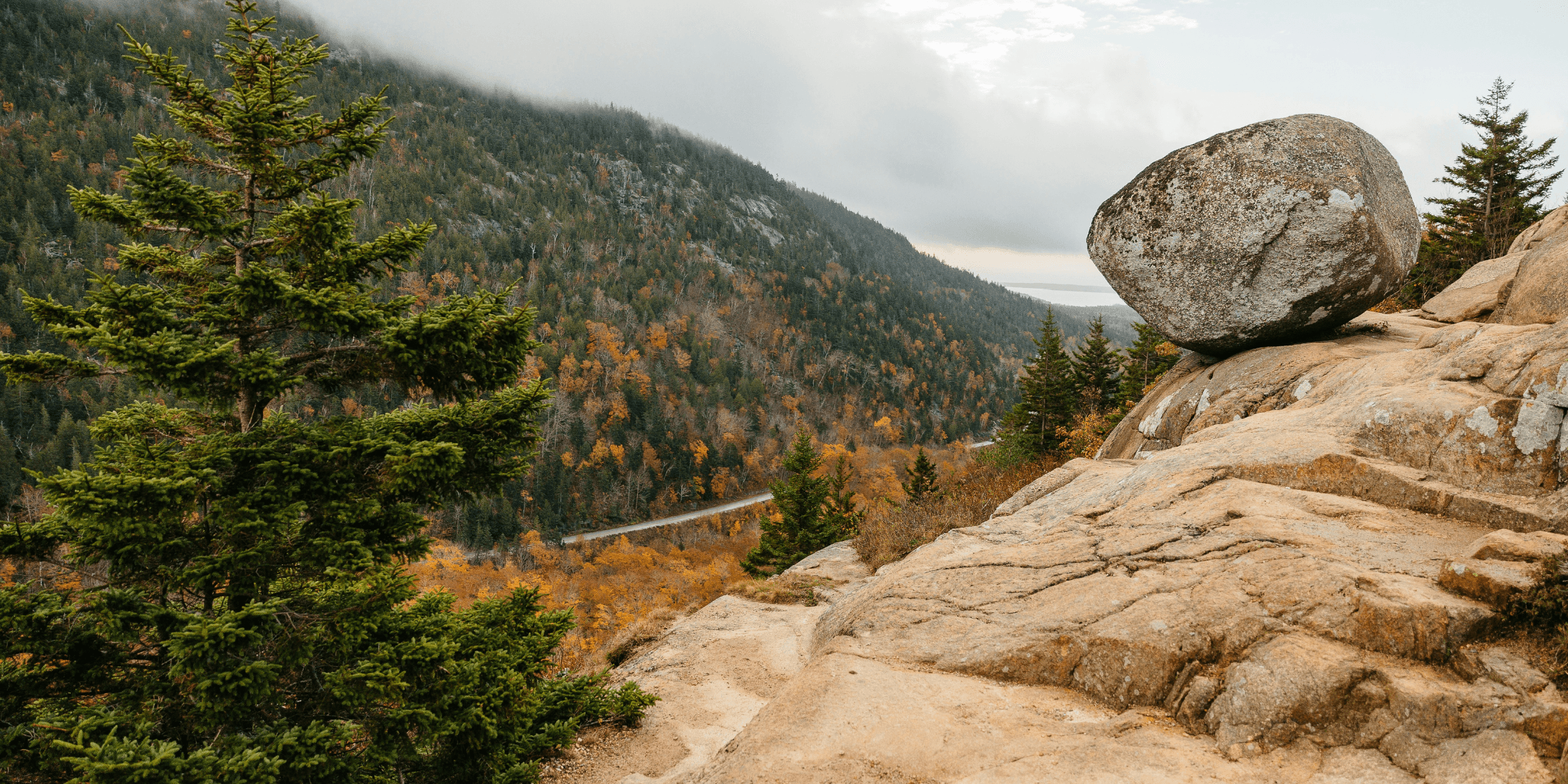
What happens when liquid fire and freezing ice combine? This unique landscape was formed from a volcano deep inside Acadia National Park that never erupted. This is how Acadia's pink granite is explained - and if you visit, you'll see that this pink glittering rock is everywhere! Glaciers got to work once this granite was formed, and like a slow bulldozer, formed this beautiful area and deposited an enormous boulder (Bubble Rock) along the way!
Loon audio courtesy of Dr Jay Mager from Ohio Northern University
Thank you for listening to our kids podcast about National Parks!
Never Miss an Episode
Get notified when we release new episodes
Join our community of nature lovers and curious kids!
Episode Transcript
National Park Scouts · Acadia National Park
Granite, Glaciers & the Boulder That Refuses to Budge
Host: Jenni · Topic: Geology, glaciers, Bubble Rock, the common loon
Intro
Close your eyes. It is pitch black. You're standing on a mountain in Maine, and the wind is freezing. You can't see the ocean below you, but you can hear it crashing into the dark. Then - bam - a tiny streak of neon orange cuts across the sky. It gets brighter and brighter until the sun cracks over the edge of the earth and hits you right in the face.
Guess what? At this exact second, you are the first person in the entire United States to see today's sunrise. Why? Because you're standing on Cadillac Mountain, the highest point on the East Coast. But how did this giant mountain get here, sticking out into the Atlantic Ocean? To figure that out, we have to travel back 420 million years. Let's go!
Welcome to National Park Scouts, the show where curious kids discover America's wildest places. I'm Jenni. Last time at Acadia, we met the Peregrine Falcon, the fastest animal on Earth. Today we're going deeper. Way, way deeper. We're going into the rock itself. We're gonna find out why everything at Acadia is pink. We're gonna talk about the mile-thick wall of ice that bulldozed across Maine and basically built the whole park. And we are going to visit the most famous boulder in New England - 28,000 pounds of rock that absolutely has no business being where it is. By the end of this episode, we'll have answers to all our questions.
The Pink Rock
Why is everything at Acadia pink?
The first thing almost everyone notices when they arrive at Acadia: everything is pink. The cliffs, the trails, the mountain - all of it the same rosy warm pink. It's a lot of pink. If pink had a fan club, Acadia would be the president.
That rock is called granite. It's pink because of a mineral packed inside called potassium feldspar. If you visit and look closely at the rock, you can actually see crystals glittering inside of it - feldspar, quartz, and hornblende. The mountain has built-in glitter, which is pretty cool.
Here's the part most adults don't know. This granite - the rock you're walking on - is the inside of an ancient volcano. About 420 million years ago, long before the dinosaurs, long before anything was walking on land, there was a massive volcanic system here. Magma was pushing up toward the surface. It was trying to erupt. But it didn't make it. It got stuck underground and just sat there, cooling for millions and millions of years until it hardened into solid rock. Scientists call it the Cadillac Mountain Intrusive Complex. I think of it as a volcano that tried really hard and just couldn't quite pull it off.
So when you stand on Cadillac Mountain and look out - islands scattered across the ocean below, glacier-carved lakes glittering behind you - you're standing on top of 420 million-year-old magma. That pink rock under your feet used to be glowing liquid fire.
Now, hold on to a question while we keep going. If all the rock at Acadia is pink volcano granite, why is there a massive boulder sitting on the mountain next door that's completely gray? We'll get to that.
The Glacier
The mile-thick wall of ice
Something is happening in Maine. A glacier is eating it. Not a glacier like a little patch of mountain ice - a wall of solid ice over a mile thick. To picture a mile of ice: take the Empire State Building. It's really tall, right? Now stack five of them on top of each other. That's still not a mile. Now make the whole thing solid ice and spread it across the entire state of Maine. That's what was sitting on top of Acadia.
Glaciers move slowly - maybe a few feet a year. But they have unbelievable force. The rocks frozen inside the bottom of the glacier grind against everything underneath. Here's the best way to describe it: imagine dragging sandpaper across wood. Now make the sandpaper a mile of solid ice, make the wood solid granite, and run it for thousands of years without stopping. That's what happened to Acadia.
The glacier polished the pink rock until it almost shines. It scraped the tops of mountains totally bare - that's why Cadillac Mountain has no trees on top. The glacier just removed them; didn't ask, didn't apologize either. It carved deep valleys that filled with water and became lakes. Jordan Pond, Eagle Lake, Echo Lake. Every lake in Acadia is basically a hole the glacier dug and then forgot to fill back in.
If you hike up Cadillac Mountain, you can find long parallel scratches in the rock. They're called striations, carved by rocks frozen in the bottom of the ice. Thousands of years later, still right there - like the glacier left its signature.
But the glacier didn't just pass through Acadia. It built it. Every bare summit, every lake, every polished pink cliff - the glacier's work. And it left something else behind. Something interesting. That gray boulder.
Park Sound
Guess that park sound
Okay, scouts - we're going to leave Acadia for a minute and play Guess That Park Sound. What do you think is making that sound? Hold your guess and we'll be right back.
The common loon
That sound is a common loon - a bird that lives on Acadia's lakes. The same lakes the glacier carved out thousands of years ago. No glacier, no lakes. No lakes, no loons. Everything in this park connects.
Loons are underwater hunters. They dive up to 200 feet to catch fish and hold their breath for five minutes. Scientists have found loon fossils that are over 20 million years old. The loon you just heard has basically been the same bird since before most mountains existed.
Thank you to Dr. J. Major for generously providing the loon audio for today's episode. Dr. Major researches and teaches at Ohio Northern University.
Ad Break
[Ad copy to be inserted here.]
Bubble Rock
The boulder that traveled 30 miles
On top of South Bubble Mountain, right above Jordan Pond, there's a boulder. It's about the size of a minivan. It weighs 28,000 pounds - roughly as heavy as two full-grown elephants. And it's sitting right on the edge of a cliff, looking like it's about to fall.
Here's where the mystery from earlier gets solved. The rock underneath Bubble Rock - the mountain itself - is pink Cadillac Mountain Granite, the ancient volcano stuff. But Bubble Rock is completely gray; it's a type of granite called Lucerne granite, from near a town about 30 miles away. Same mountain, two totally different rocks. One belongs here and one does not.
So how does a 28,000-pound boulder end up 30 miles from home? The glacier picked it up. When that mile-thick wall of ice moved through, it grabbed this boulder right out of the ground near Lucerne and carried it - all 28,000 pounds - the whole way to Acadia. When the ice melted, the boulder was set down wherever the glacier happened to stop holding it, which was the edge of a cliff.
Geologists call it a glacial erratic. Erratic means out of place, wandering, lost - and Acadia is full of them, from mountaintops to beaches. But Bubble Rock is the most famous.
Here's a fun thing about Bubble Rock. Everyone who hikes up there tries to push it off. Kids, adults, entire families - they lean into it, they grunt, they make the face. Every single one of them fails. It's not moved one centimeter in 16,000 years. But when you visit, you have to try. It's basically required.
Wildcard
Two truths and a lie
Three facts. Two are real. One I made up. You get to figure out which one.
Statement 1The pink color in Acadia's granite comes from a mineral called potassium feldspar.
TRUE - Potassium feldspar is exactly what makes the granite pink. You can actually see those crystals if you look closely at the rock.
Statement 2Bubble Rock weighs 28,000 pounds and came from about 30 miles away.
TRUE - 28,000 pounds, 30 miles from home, dropped on the edge of a cliff by a melting glacier. All confirmed.
Statement 3The glacier that shaped Acadia was as thick as a three-story building - around 30 feet of solid ice.
FALSE - The glacier was not 30 feet thick. It was over a mile thick. A 30-foot glacier doesn't scratch mountains. A mile of ice does.
Scout Question
Scout Question of the Day
If you could go anywhere in the world to watch a sunrise, where would you go?
Hunter, age 6I would watch the sunrise at the beach.
Eli, age 5I would watch the sunrise at Kauai because I love it.
I love hearing your answers. For what it's worth, mine is my family's cabin on a lake. I love watching the sun come up over the mountains - probably because I have such great memories of that place. Do you want your voice on the show? Ask an adult to help you find the contact form at nationalparkscouts.com, or follow along on social media to catch the next scout question.
From Jenni
If you're loving the show so far, do us a big favor - hit that subscribe button right now and leave us a five-star review. It takes a few seconds, but it's the absolute best way to help other people find the podcast.
Scout Mission
Your Mission
Every scout needs a mission
What did you learn today that most adults don't know? That the pink granite at Acadia is the inside of a volcano that never erupted - magma that cooled underground 420 million years ago. Most people walk right past it. But it used to be liquid fire. Not just pretty pink rock.
If you're at home: go outside and find a rock - any rock, driveway, yard, wherever. Look at it closely. Does it sparkle? It might have crystals from old volcanic rock. Is it smooth and rounded? That means something carried it - water or maybe ice. Make a theory. You are a geologist now.
If you're at Acadia: hike the South Bubble Trail to Bubble Rock. When you get there, look at the pink rock of the mountain, then look at the gray boulder sitting on top of it. Two totally different rocks, brought together by a glacier. Take that in for a second - and then try to push it. You will not move it, but the effort is pretty much part of the experience.
Outro
And the first sunrise of the United States. That's Acadia.
Next time, we're heading to the coast - crashing waves, dramatic cliffs, and some of the most wild water on the Atlantic.