Rocky Mountain National Park: Pika Survival Secrets
Episode 011
20 minutes
Listen to this episode
Also available on:
Episode Description
What's cute, furry, and lives all winter in the alpine tundra at Rocky Mountain National Park? Pikas! These cute little animals live in the harshest place on earth in the talus rocks. We hear their mountain alarm system, we watch them gather their hay piles, and we learn a little about where they live: the alpine tundra. This windswept, harsh place has more life than you might expect. Grab your parka, this episode takes us above the clouds!
Never Miss an Episode
Get notified when we release new episodes
Join our community of nature lovers and curious kids!
Episode Transcript
National Park Scouts
Six Ounces of Pure Determination
Host: Jenni Park: Rocky Mountain National Park Topic: The American Pika & Alpine Tundra
Intro
That sound was made by an animal about the size of a tennis ball. It lives at the top of the Rocky Mountains, where it is freezing cold, where the wind never stops, and where almost nothing can survive. It does not hibernate, it does not migrate - it just stays all winter long at 12,000 feet in the dark under the snow. And if you get too close to its home, it will scream at you loudly, like it has absolutely no idea how small it is. Today we are going to find out exactly how this tiny, furious, but very cute little animal pulls that off. Let's go.
Welcome to National Park Scouts, the show where curious kids discover America's wildest places. We are back in Rocky Mountain National Park in Colorado. Last time we drove Trail Ridge Road all the way to the top. We crossed the Continental Divide - the invisible line where rain heads to two different oceans. We watched the forest disappear right at the very top. Standing on the open tundra, I told you there was a small, round, very loud animal up there that survived the winter without hibernating. And that we would be back to meet it. Today is that day.
Before we meet our animal, I have a question I want you to think about. Pikas are incredible little survivalists, and one of the things they do to get through the winter is to go on what I think might be the most impressive grocery run in the entire animal kingdom. Here is my question. How many trips do you think a pika makes in a single summer gathering food for the winter? Is it a hundred? A thousand? More? I'll give you the answer later. And I promise you are going to be shocked.
The Alpine Tundra
The world the pika calls home
Before we meet our animal, we need to understand the world it lives in - because where a pika lives is almost as wild as the pika itself. We are back above the tree line, up where the trees gave up and the forest simply stopped. Up here, the land is open and rocky and windswept. And it has a name: the Alpine Tundra.
Here is something that surprises a lot of people. One-third of Rocky Mountain National Park is tundra. Not trees, not meadow - tundra. Open, wild, treeless tundra stretching in every direction. Most national parks have almost none of it. Rocky Mountain is practically made of it. And it is one of the only places in America where you can actually get to it without a serious backcountry hike. You drive there on Trail Ridge Road.
But do not let the easy access fool you. The tundra is extreme in ways that are hard to imagine until you are standing in it. The wind on Trail Ridge Road can hit hurricane force - strong enough to knock over an adult who is not braced for it. It can snow in July. In fact, temperatures drop below freezing on the Alpine Tundra every single month of the year. The number of days warm enough for plants to actually grow is 45 days. That is it. Six and a half weeks. Your whole summer vacation is longer than the tundra's entire growing season.
Now, if you listened to our first Rocky Mountain episode, you heard about the glaciers that carved this park. Those massive walls of ice left something behind when they retreated: piles of shattered, broken rock called talus. Huge jumbles of boulders, cold air flowing through the gaps between them. And as we are about to find out, that talus is extremely important to our animal.
The tundra looks tough and rugged, but the plants and soil up here are actually incredibly fragile. If you pressed your boot into the tundra soil and left a footprint, that footprint could take 100 years to disappear. The plants grow so slowly that a single bootprint can outlast your great-great grandchildren. Up here, every step counts.
In spite of all that harshness, the tundra is not empty. In those 45 short days, wildflowers bloom across the rocks in places you would not expect. There is one called Sky Pilot that smells exactly like a skunk - not a little bit, actually like a skunk. And there is my favorite: the alpine sunflower, sometimes called Old Man of the Mountain. This plant stores energy in its roots for up to 30 years, then sends up one single flower, blooms once, and dies. Scientists have found the exact same tiny plants growing up here that grow in the Arctic, thousands of miles away - because this mountain is so high and so cold, it built its own little Arctic right here in Colorado.
Meet the Animal
The American Pika
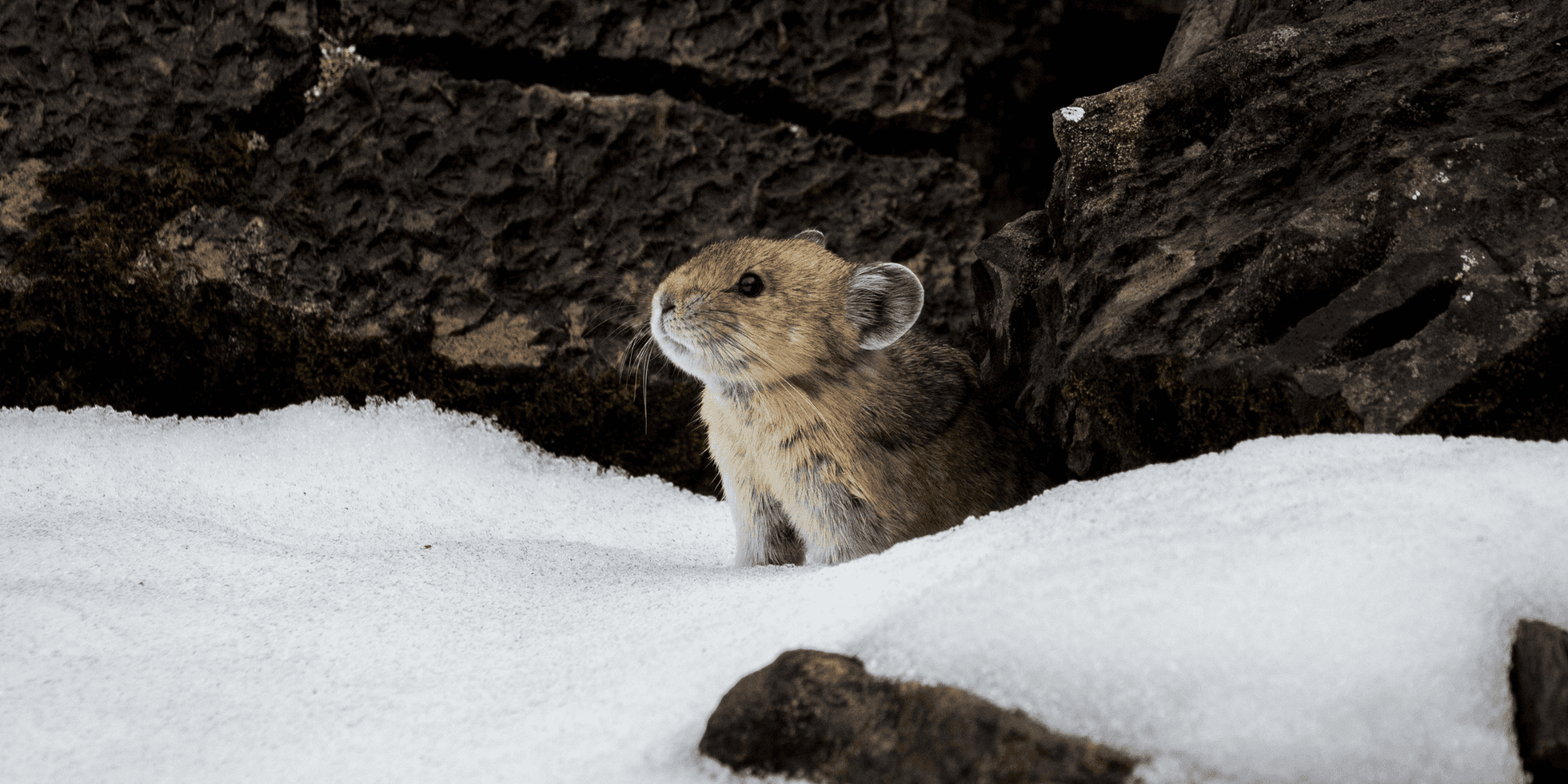
If you have never seen a pika, picture this. Take a hamster, make it a little rounder, give it tiny round ears, remove the tail completely. No tail - just a round little body. That is a pika. They are about six to eight inches long. They weigh maybe six ounces, about as much as a baseball. They are objectively one of the most adorable animals in North America. And they know it, and they do not care, because they are extremely busy.
Here is something that surprised me. Pikas are not rodents. They are not related to mice or squirrels or any of that. Pikas are actually distant cousins of rabbits - the same scientific family called Lagomorpha, which is a fun word to say - but they look absolutely nothing like a rabbit. No long ears, no fluffy tail, no hopping. They scurry like a very determined potato.
That sharp little bark you heard? That is the pika alarm call. And pikas are not shy about using it. If a hawk circles overhead - alarm call. If a coyote wanders past - alarm call. If a hiker comes too close to the talus - alarm call. The pika is the self-appointed security guard of the Alpine Tundra, and it takes the job very seriously.
Here is why pikas live up high where it is so cold. A pika's body temperature runs at about 104 degrees Fahrenheit. That sounds hot, but the problem is they cannot cool down very well. If a pika gets too warm - say the weather warms to above 78 degrees Fahrenheit - the pika can overheat and die. 78 degrees is a nice spring day to us, but to the pika, that is dangerous. So they live up high where it stays cold. The rocky talus is like their refrigerator. Cool air flows through the gaps between the boulders and keeps their little world at just the right temperature. The talus is also their home, their pantry, and their fortress. Each pika has its own section of talus that it defends fiercely.
Ad Break
[Ad copy goes here]
Guess That Park Sound
What was that crashing sound?
Okay, scouts - we are going to take a little break from our pika. First, guess that park sound. I am going to play you a sound recorded right here in Rocky Mountain National Park. It is not our pika, but listen carefully and see if you can figure out what is making this sound.
That crashing, thrashing, incredibly dramatic sound? That is a bull elk. A male elk ramming and thrashing his antlers into a bush. Every fall, bull elk have a competition to see who is the biggest and toughest on the mountain. They thrash bushes, tear up the ground, and make this haunting bugling call that echoes off the canyon walls. It is basically the elk version of a shouting match, and it is loud. You can hear it from a mile away.
You might be thinking - what does an elk have to do with our pika episode? Elk and pikas actually share more of the same world than you might expect. I am going to save exactly how for the wildcard later, because I think it is going to surprise you.
The Grocery Run
14,000 trips
Pikas do not hibernate. They cannot migrate. Their bodies overheat too easily at lower elevations. So when winter hits and the tundra disappears under several feet of snow, the pika is still up there - it just goes underground, into the spaces between the talus rocks. And to survive, it needs food. A lot of it.
So all summer long, during those 45 precious warm days, the pika does one thing obsessively. It gathers plants - grasses, wildflowers, leaves, stems. It carries mouthfuls back to the talus, tucks them under the rocks, and then goes back for more. Over and over again. This pile of gathered and dried plants is called a hay pile. Researchers have counted how many trips a single pika makes in a summer to build one.
Remember the question from the beginning of the episode? The answer is 14,000 trips. One pika, one summer, 14,000 individual foraging trips. If that summer is 45 days long, that is more than 300 trips every single day - more than one trip every five minutes, all day long, for the entire summer.
Here is the part that is most impressive. Some of the plants the pika collects are actually toxic - poisonous to other animals. But the pika knows something the other animals do not. If you let those plants dry out in the sun first, the toxins break down and the plants become safe to eat. So pikas deliberately spread certain toxic plants out on the rock to dry, like tiny little chemists, and only add them to the hay pile once they are safe.
And one more thing about the hay pile. Each pika guards its own pile like it is made of gold - because to them it basically is. Neighbors do steal from each other. And if a pika catches another pika raiding its pile, things get loud. You will hear about it.
Surviving Winter
The Subnivean Zone
Let us think about what winter actually looks like on the Alpine Tundra. The temperature can drop to 30 below zero. The wind never really stops. The snow piles up, sometimes covering the talus completely. And our little pika is somewhere in there - no hibernation, no migration, just a furry little animal and whatever it managed to stuff under those rocks all summer.
Here is something that sounds weird but makes total sense once you think about it. When deep snow piles up on the tundra, something happens underneath it. The snow acts like a blanket. It traps heat coming up from the ground and blocks the brutal cold from above. Under the snowpack, just above the ground, there is a thin layer of space where the temperature stays right around 32 degrees Fahrenheit. Not warm to us, but compared to 30 below zero on the surface - practically tropical. It is called the Subnivean Zone, which is a fancy way of saying the space under the snow. And that is where the pika lives all winter. It tunnels through the snow to reach its hay pile, eats, rests, waits - safe in its little underground world while the tundra howls above it.
Think about everything that had to go right for this to work. 45 days of summer, 14,000 foraging trips, a carefully sorted and dried hay pile, a knowledge of which plants are toxic and how to make them safe, and a cozy subnivean burrow to wait out the winter. This animal weighs six ounces - it is smaller than most of your shoes - and it has figured out how to outlast a Rocky Mountain winter that would defeat almost anything else. The pika was not built to be the biggest or the strongest. It was built to do exactly this, in exactly this place, better than anything else alive.
Wildcard
True or False: Tundra Edition
True or false: Pikas hibernate all winter to survive the cold.
False. No hibernation - the pika stays awake underground and eats from its hay pile all winter long. You do not make 14,000 trips just to take a nap.
True or false: Golden eagles hunt on the Alpine Tundra.
True. Golden eagles soar above the tundra looking for pikas, marmots, and other small animals. Which means our little pika - already dealing with freezing temperatures and a mountain winter - also has to watch out for one of the most powerful birds on the planet diving at it from above. The pika alarm call suddenly makes a lot more sense. The pika eats plants; the golden eagle eats the pika. Scientists call that a food chain: energy moving from plants to plant eaters to predators. The pika sits right in the middle of the tundra's food chain, which - when you think about it - is a pretty stressful place to be.
True or false: Elk come up to the Alpine Tundra in summer to escape bugs.
True. Elk leave the forests in summer and come up to the cold, windy tundra specifically to get away from biting insects. A thousand-pound elk and a six-ounce pika share the same mountaintop - one because it chose to; one because the bugs were unbearable. The tundra brings all kinds together.
Scout Question of the Day
Scout Question
Prompted by this episode's scouts
"If you had to survive a Rocky Mountain winter like a pika - no hibernating allowed - what three things would you put in your hay pile?"
Listener Responses
Addy
Plenty of books, lots of snacks, and my two cats - Stuart Little and Coconut.
Jackson
4,000 Gatorade packages, a gaming console, and a cozy bed.
Website
Want your voice on the next episode? Visit NationalParkScouts.com. You can ask a question about a park or tell us what park you want to visit next. We also have free activity pages, coloring sheets, and park bingo cards you can print and bring on your next adventure.
Scout Mission
Your Mission This Week
Think like a pika
At home: Go outside - your backyard, a park, anywhere with plants - and collect ten different things a pika might actually store for winter. Leaves, dried grass, seeds, flower petals, small twigs, whatever you can find. Lay them out somewhere sunny and flat, like a rock or a sidewalk, and let them dry out for the day, just like a pika dries its hay. Then arrange them into your own little hay pile.
If you are visiting Rocky Mountain National Park: Head up to Trail Ridge Road and look for a talus slope - a jumble of broken rocks along the roadside above the tree line. Pull over safely. Stand completely still and be quiet for 60 seconds. Listen for a sharp little bark coming from somewhere in the rocks. That is the pika alarm call, and if you hear it, the pika already knows you are standing there. Look for cracks and gaps between the boulders where cool air might flow through - that is prime pika real estate. The hay pile is hidden somewhere inside. Do not try to approach it or feed it. The pika has things to do. 14,000 things, to be exact.
Outro
Scouts, thanks for joining me today. We stood on the Alpine Tundra and watched a sunflower that waited 30 years for its one moment to bloom. We met a tiny animal that does 14,000 grocery runs a summer. That pika that screamed at us at the beginning of the episode? It was not just being dramatic. It was protecting everything - its hay pile, its territory, its entire plan for survival. Six ounces of pure determination.
Next time we are back here in Rocky Mountain, but we are heading back down - because there is an animal down there that is Colorado's official symbol, that nearly vanished and came roaring back, and whose battles are so loud you can hear the impact from a mile away. Until then, scouts - your next adventure is waiting.