Listen to this episode
Also available on:
Episode Description
How was Rocky Mountain National Park made? Find out all about the inland sea (wait! what sea?!) How the mountains grew, and why they get so much snow. Next, we learn about the imaginary line of the Continental Divide and where water flows from the roof of the continent. After that, we explore glaciers and how all those lakes showed up. Jump over the little stream that begins the Colorado River. Water is the strong thread that carves this park, listen in to learn all about it!
Resources & Links
Never Miss an Episode
Get notified when we release new episodes
Join our community of nature lovers and curious kids!
Episode Transcript
National Park Scouts
Snowflakes, Glaciers & the River That Starts Here
Host: [Host name] Topic: Rocky Mountain National Park - water, geology, glaciers
Intro
One snowflake, one mountain
A single snowflake lands on the top of a rocky mountain peak. That snowflake will melt. It will trickle into a stream. That stream will join a river. That river will travel hundreds of miles, carving canyons, filling lakes, watering valleys, and eventually it will reach the ocean. The whole journey starts here - with one snowflake on one mountain. Today, we are going to figure out how that mountain got there and why water is the secret that holds all of it together.
Welcome to National Park Scouts, the show where curious kids discover America's wildest places. Today we are starting something big - Rocky Mountain National Park in Colorado. We will spend several episodes here, and today is the foundation that makes everything else make sense. Before we meet any animals or drive any roads, we need to understand the place itself. Because Rocky Mountain National Park was built by some of the most powerful forces on Earth. And there is one thread that connects everything - the mountains, the glaciers, the lakes, the rivers. That thread is water, and it all starts with a snowflake.
I have a question for you to think about today. The Colorado River is one of the most famous rivers in America. It carves the Grand Canyon, it flows through seven states, and it supplies water to about 40 million people. Here is my question - where does it start? Where does this massive, powerful river actually begin? I will give you the answer before the end of the episode, and I promise it is not what you expect.
Topic Segment
How the mountains got here
Before we can talk about water, we need to talk about what the water falls onto - the mountains. And to understand the mountains, we need to go back in time. Way, way back.
70 million years ago, when dinosaurs were still walking the earth, the land where Colorado sits today looked completely different. There were no mountains. Where the Rocky Mountains stand today, there was a shallow inland sea - a warm, flat sea covering the middle of North America. If you had a time machine and went back 70 million years and stood where Denver is today, you would be standing underwater.
And then something happened deep inside the earth. Enormous forces started pushing the rock upward from below. Not like a volcano exploding - more like a very, very slow collision. The rock buckled and folded and rose. Over millions of years, the sea drained away and the mountains pushed up through the surface.
The Rocky Mountains are actually considered young, geologically speaking. The Rockies are only 70 million years old - like a toddler mountain. They still have their edges. Inside Rocky Mountain National Park alone, there are more than 60 peaks above 12,000 feet. The tallest, Long's Peak, reaches 14,259 feet into the sky. That is nearly three miles straight up.
What glaciers did to this place
After the mountains rose, the climate on Earth changed. It got colder. Snow piled up faster than it could melt. Over hundreds of years, all that packed snow turned into something else - massive, heavy, slow-moving rivers of ice. Glaciers.
A glacier is not just ice sitting still. It moves very slowly - maybe a few feet per year - and as it moves downhill, it carves. Rocks and gravel frozen into the bottom of the glacier grind along like sandpaper. The glacier scrapes the valley walls, digs into the floor, and carries enormous boulders for miles.
Before glaciers, river valleys tended to be V-shaped - narrow at the bottom. When a glacier moves through, it bulldozes. It widens the floor and steepens the walls until the valley looks more like the letter U - wide and flat at the bottom with dramatic steep sides towering above. Almost every valley in this park was carved that way.
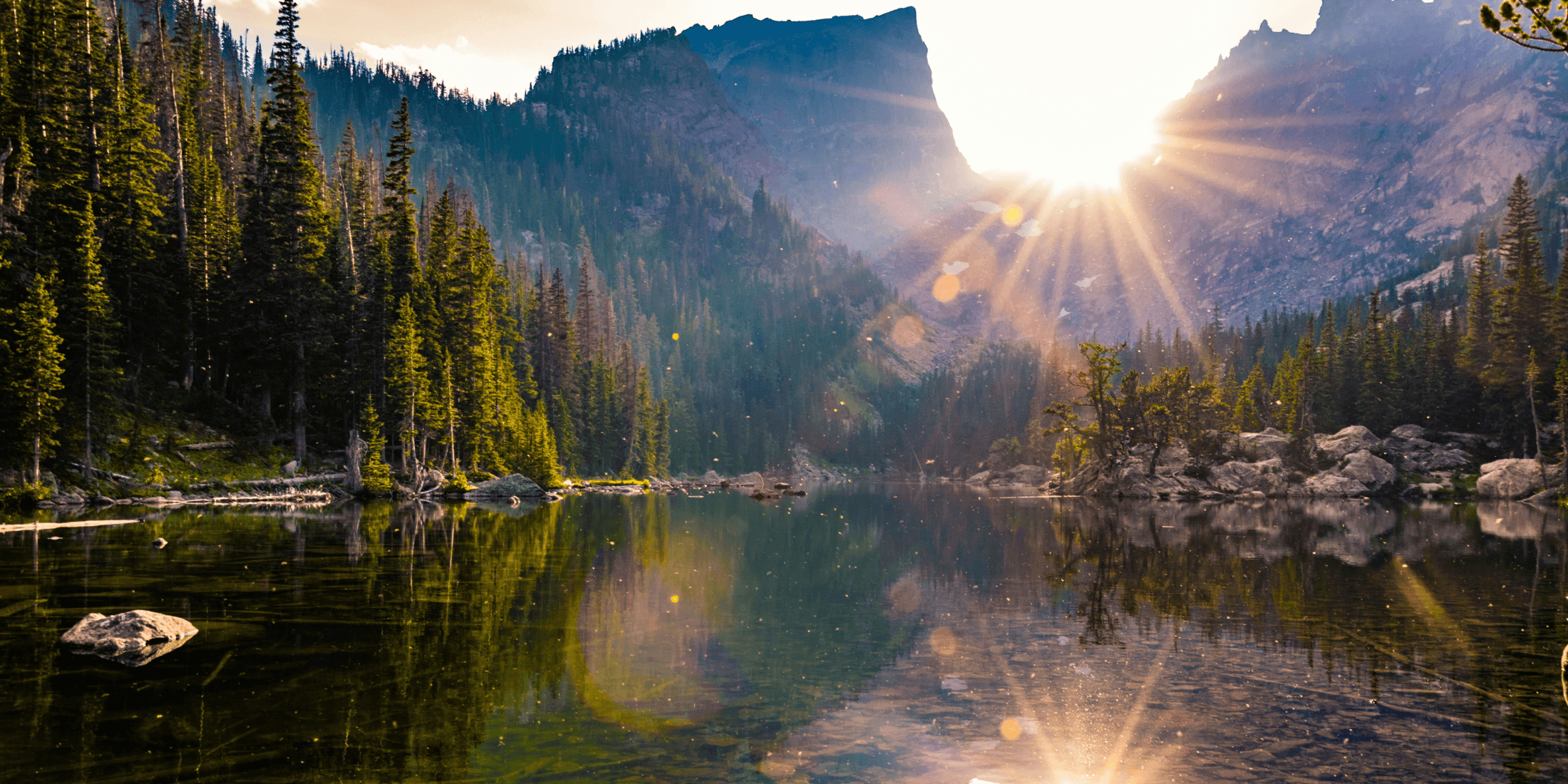
When the glaciers finally melted, they left behind deep basins carved out of solid rock and piles of debris that acted as natural dams. Water collected in those basins - Bear Lake, Dream Lake, Emerald Lake - every one of them sits in a bowl that a glacier dug out of solid rock thousands of years ago. Those lakes did not just appear; they were carved by ice. And seven small glaciers still exist inside Rocky Mountain National Park today.
Topic Segment
Why it snows in July
Storm clouds form over the Pacific Ocean and they move east across the country. They carry enormous amounts of moisture - water vapor just waiting to fall as rain or snow. And for most of the journey, those clouds keep moving, but then they hit the Rocky Mountains and they can not get over. The mountains are simply too tall. So the clouds are pushed upward, and as they rise, the air gets colder, and when clouds get cold enough, they drop their moisture right here - right onto these peaks.
The west side of Rocky Mountain National Park gets buried in snow. And at the very top of the park - up on Trail Ridge Road in the high peaks - it can snow every single month of the year. Visitors have gotten caught in snowstorms in July. In August. The mountain does not care what your calendar says.
Scout joke
What do you call a snowman in the summer? A puddle. But maybe not here at Rocky Mountain National Park.
Topic Segment
Where the water goes - and the answer to the big question
All that snow does not just sit there. Every spring and summer it melts. And that snowmelt becomes every stream, every river, every waterfall, every lake in this park. The water you see rushing down a mountain creek in July - that was a snowflake in January. The crystal-clear lake reflecting the peaks above it - snowmelt, filtered for years through layers of rock.
And now the answer to the question I asked at the beginning - where does the Colorado River start?
It starts right here, inside Rocky Mountain National Park. On the west side of the park, near a place called La Poudre Pass. A tiny trickle of water emerges from a wet mountain meadow. It is so small you could step over it. You could literally jump across the beginning of the Colorado River. But that trickle flows into a stream, the stream joins other streams, and eventually - after traveling more than 1,000 miles - it carves the Grand Canyon. It flows through Utah, Arizona, Nevada, and California. It supplies drinking water to 40 million people across seven states. And it starts as a snowflake on a Rocky Mountain peak that melts into a trickle you could step right over.
Sound Break
Guess that park sound
I am going to play you a sound recorded right here in Rocky Mountain National Park. Listen carefully and see if you can guess what it is.
Ad Break
[Break - answer revealed after this spot]
So that sound is thunder. And not just any thunder - that is a Rocky Mountain afternoon thunderstorm rolling across Trail Ridge Road. Every single afternoon in summer, like clockwork, storm clouds build over the peaks. By early afternoon, the sky goes dark. Lightning flashes, thunder echoes off the canyon walls in a way that sounds nothing like thunder anywhere else.
We just spent a whole segment talking about how storm clouds hit these mountains and drop their moisture as rain and snow. The thunderstorm is the same story - happening right in front of you in real time. One thing every visitor should know: if you are up high on Trail Ridge Road or on a peak above the tree line, you want to be heading back down by early afternoon. Those storms come in fast. But from a safe spot below, they are spectacular.
Topic Segment
145 lakes you have probably never heard of
Rocky Mountain National Park has about 145 named lakes. Most of them were carved by glaciers, filled by snowmelt, and surrounded by peaks that reflect perfectly in the water on a still morning. These are not ordinary lakes. Alpine lakes look different from any lake you have probably seen - the water is extraordinarily clear. Some of them have a blue-green turquoise color from glacial rock flour, tiny rock particles ground up by glaciers and suspended in the water, catching the light in a way that makes the whole lake glow.
On the east side of the park, there is a chain of lakes connected by one trail that families hike all the time - Bear Lake to Nymph Lake to Dream Lake to Emerald Lake. Each one higher and wilder than the last. About three miles round trip, and every step looks like a painting.
Trip Planning
Places to add to your list
If your family is planning a trip to Rocky Mountain National Park - or just dreaming about it - here are some places to look into.
Bear Lake. Start here. Bear Lake is the most accessible alpine lake in the park. A short flat walk from the parking lot that anyone can do, including very young kids. The water is crystal clear and the peaks reflect on a calm morning. Arrive early.
Sheep Lakes at Horseshoe Park. From May through August, bighorn sheep come down out of the mountains and lick minerals from the soil right next to the road. You can watch from your car window. No hiking required.
Trail Ridge Road. The highest continuously paved highway in America. We have a whole episode dedicated to it - what is at the top is unlike anything most people have ever seen.
The Alluvial Fan. We spent this whole episode talking about the power of water, and the Alluvial Fan is where you can see it at work. This rocky, fan-shaped landscape near Horseshoe Park was created by a massive flood that deposited giant boulders across the hillside - boulders the water carried and dropped like pebbles. In midsummer through fall, kids can get their feet wet in the shallow stream and climb on the rocks.
Wildcard - Trivia
Rocky Mountain National Park trivia
Rocky Mountain National Park has more than 60 peaks over 12,000 feet. How many reach 14,000 feet or higher - is it one, five, or twelve?
Just one. Long's Peak is the only peak in the entire park that crosses 14,000 feet. Hikers and climbers in Colorado have a tradition of trying to summit all peaks over 14,000 feet - they call them "14ers." Most people do not need oxygen tanks or technical gear to attempt one; just strong legs, good boots, and an early start.
How many named lakes are in Rocky Mountain National Park - is it 20, 75, or 145?
145 named lakes. Most people think about five or ten famous ones - Bear Lake, Dream Lake, Emerald Lake. But the park is absolutely full of them, all carved by glaciers, all filled by melted snow.
Scout Question
Scout question of the day - from Brielle, age 10
"I know that mountains are made by tectonic plates. My question is - are the Rocky Mountains still growing?"
Great question. The answer is no. Mountains grow when the forces underground pushing them up are stronger than the forces of weather wearing them down. 70 million years ago, the Rockies were rising fast. But the pushing has slowed down, and now the weather is winning - very slowly. Every year, the Rockies get a tiny bit shorter, but it is so tiny you would need millions of years to notice it.
Scout Mission
Your mission
Build your own glacier
Fill a small container with water and mix in a handful of small gravel or coarse sand. Freeze it completely overnight. This is your glacier block - with rocks frozen into the bottom, just like a real glacier.
The next day, take a tray or container, or even a sandbox, and pack it with damp sand. Shape the sand into a mountain with a V-shaped valley - narrow at the bottom and wider at the top, like the letter V. Now take your ice block and slowly push it down the valley. What happens? What shape is the valley now? You just did what took glaciers thousands of years to do - in about five minutes.
If you are visiting Rocky Mountain National Park, head to Bear Lake. When you get there, do not just look at the lake - look up. Look at the walls of the valley around you. Steep on the sides, wide and flat at the bottom. That shape was carved by a glacier - a river of ice, hundreds of feet thick, that ground through this valley thousands of years ago. Can you imagine that? Touch the water and see how cold it is. The glacier is gone, but everything it built is still right here.
Outro
Next time
Scouts, thank you for exploring Rocky Mountain National Park with me today. We learned about one snowflake - and that is where it all starts. Next time, we are getting in the car. Rocky Mountain National Park has a road that takes you so high the trees give up. And at the top, you can stand on a line that splits two oceans.