Rocky Mountain National Park: Bighorn Sheep Battle on the Peaks
Episode 012
Listen to this episode
Also available on:
Episode Description
Crack! Two Bighorn Sheep ram their heads together. Again and again, for hours. In this episode we take a look at the mighty bighorn sheep of the Rockies. These sheep invented crash engineering; we learn why their brains don't get scrambled, then marvel at their power and agility on cliff faces. We can see them licking the dirt at Sheep Lakes - yes really! The symbol of Rocky Mountain National Park has a lot to share, lets dive in together.
Resources & Links
Never Miss an Episode
Get notified when we release new episodes
Join our community of nature lovers and curious kids!
Episode Transcript
National Park Scouts
Bighorn Sheep: Built for the Mountain
Host: Jenni·Park: Rocky Mountain National Park·Topic: Bighorn sheep, adaptations, wildlife
Intro
Did you hear that? Two rams running straight at each other at full speed - about forty miles an hour each. That's faster than you're allowed to drive through a school zone. And then - boom - head to head. It sounds like a baseball bat cracking against a wooden fence, except louder. And it echoes off the canyon walls. You can hear it from an entire mile away.
The crazy thing is that these animals do this on purpose. Every fall, bighorn sheep charge head to head to see who is the toughest, the strongest, and whoever wins gets to be in charge. They live right here in Rocky Mountain National Park, and today we are going to figure out exactly how they pull that off without knocking themselves out cold. Let's go!
Welcome to National Park Scouts, the show where curious kids discover America's wildest places. I'm Jenni and we are back in Rocky Mountain National Park - one of the most visited parks in the entire country, sitting right in the middle of Colorado.
We've spent three episodes here so far. We learned how these mountains were built - a lot of colliding plates, and a lot of time. We drove Trail Ridge Road, the highest continuous paved road in America. And we met the pika, a tiny animal that lives above the tree line and screams at hikers. Genuinely screams at them.
Today we are coming back down the mountain to meet the animal that is the symbol of this park. It's on the signs, it's on the logo, it's Colorado's official state animal. And it is one of the most jaw-dropping, physically remarkable animals on the planet. Let's meet the bighorn.
Meet the Bighorn
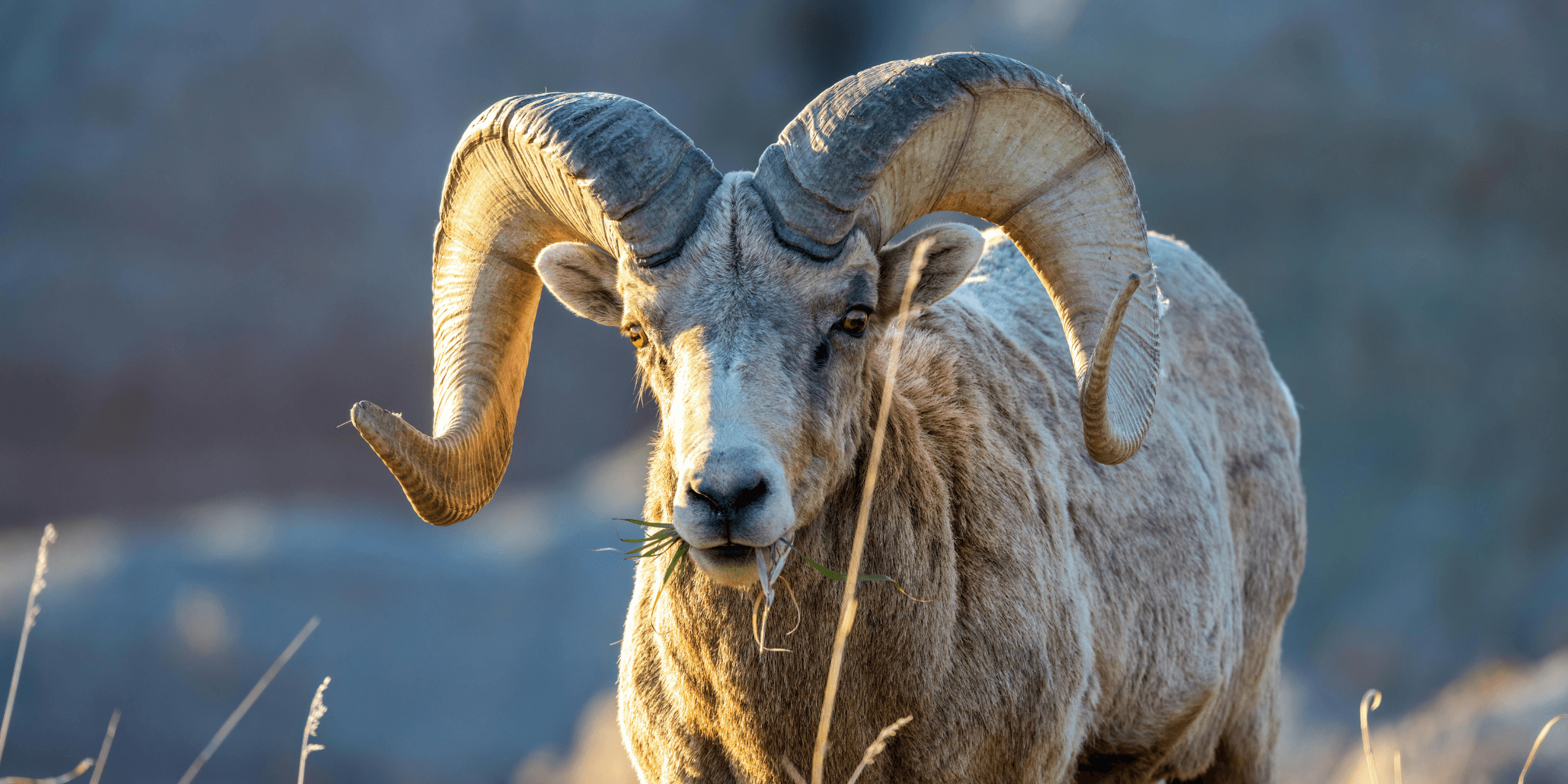
Rocky Mountain bighorn sheep are the largest wild sheep in North America. A full-grown ram - that's the word for a male bighorn - can weigh over 300 pounds. That's about as heavy as a very large black bear. The females are called ewes, spelled E-W-E, which is one of those words that looks completely wrong but sounds exactly like the word "you."
The Horns
A bighorn ram's horns are not just big - they are extraordinary. They start growing when the ram is born and they never stop. Never. The older the ram gets, the longer and more curled the horns become. By the time the ram is about seven or eight years old, those horns have made a full curl, wrapping all the way around like a giant letter C pressed against the side of his face.
You can tell exactly how old a ram is just by looking at his horns. Every year of his life leaves a ring on the horn, just like the rings inside a tree trunk. Count the rings, know the age.
The Eyes
Now I want to tell you something about bighorn eyes. Their pupils - that's the dark part in the center of the eye - are not round like yours. They are rectangular, like a little rectangle floating in the middle of their eye. It sounds creepy, it is kind of creepy, but there's a reason for it. Those rectangular pupils give bighorn sheep a field of vision of about 320 degrees. You and I can see maybe 180 degrees if we look all the way to both sides. Bighorn sheep can see almost all the way around their head without turning it. They can spot a mountain lion from a mile away. Next time you think you've got eyes in the back of your head - you don't. But a bighorn sheep basically does.
Social Life and Lambs
Rams and ewes basically live completely separate lives almost all year long. The rams hang out in bachelor groups. The ewes live in family herds led by an older female who knows all the best trails and the safest spots. The two groups only come together in the fall.
Baby bighorn sheep are born every spring. Ewes climb to the highest, steepest cliff ledges to give birth - on purpose, because predators can't follow them up there. And a bighorn lamb born on a narrow ledge, sometimes in a snowstorm, is walking within a few hours of being born. Hours, not days - hours. Golden eagles are their biggest threat up there. But those lambs are up and moving fast.
The Hoof
Imagine someone designed the perfect shoe for climbing rocks. Not sneakers, not hiking boots - the absolute best possible shoe for gripping a cliff face, sprinting across loose gravel, and jumping from one narrow ledge to another. That is the bighorn sheep hoof.
The hoof has two parts working together. The outside edge is hard, like the rim of a shoe sole - it digs into rock edges and grips tiny protrusions in the cliff face, almost like a clamp. The inside pad is soft and spongy, like the bottom of a sneaker; that part molds to the surface and creates grip on slopes where anything else would slide right off.
The hoof is split into two toes that can spread apart and squeeze back together - they can pinch around rocks kind of like a clothespin. A bighorn sheep can use those toes to grab a ledge that is literally two inches wide. That's about as wide as two of your fingers. And they do this while running.
A bighorn sheep can run 30 miles per hour on flat ground. It can balance on two-inch ledges and jump 20 feet from rock to rock - 20 feet is roughly the height of a two-story building, and they jump that sideways. Scientists call all of this an adaptation; the word for when an animal's body develops a special feature that helps it survive in its environment. Everything about that hoof was built for one job: staying alive on a cliff face.
Guess That Park Sound
Okay, scouts - it's time for Guess That Park Sound. A real sound recorded right here in Rocky Mountain National Park. Big sound, right? You'd think a big animal - but that is the Western Chorus Frog. About the size of a large grape. A grape with legs. Apparently it has a lot to say.
Western Chorus Frogs live in the wetlands and meadows of Rocky Mountain National Park - Moraine Park is one of the best places to hear them. All winter they hide under rocks and logs, but every spring, when the snow melts and the meadows fill with water, hundreds of them come out and sing together, almost all at the same time. That's why they're called chorus frogs. One tiny frog makes almost no sound; get a few hundred together at dawn, and that's what you heard.
Most visitors drive right past them and never know they're there. But now you do. Next time you hear that sound in the park, you'll know exactly what's happening - a bunch of grape-sized frogs throwing the loudest party in the mountains.
Ad Break
[Ad break - sponsor message goes here]
The Rut
The Battle for the Mountain
Every fall, something incredible happens right here in Rocky Mountain National Park - something you can actually witness yourself if you visit at the right time. The bachelor ram groups and ewe herds come together, and the rams need to figure out who's in charge; who is the strongest, toughest, most impressive ram on the mountain. The way they settle it is by running at each other as fast as they can.
But first, there's a whole buildup. Two rams spot each other. They walk slowly toward each other, sizing each other up. Then comes something called a threat jump - a ram rears up on his hind legs to look as tall and massive as possible. It's basically the world's scariest version of standing on your tippy toes. Then the stare down. Two massive rams, nose to nose, not moving - like a standoff in a Western movie.
Sometimes one of them just backs down, right there - because the horns themselves are the scoreboard. The bigger and more curled the horns, the higher the rank, automatically. A younger ram takes one look at a full curl and decides today is not the day. But when neither backs down, they both rear up, they turn, and they charge. Forty miles an hour. And they do it over and over until one of them walks away.
The Crash Helmet
So how is it possible that a bighorn sheep's head survives that again and again without scrambling his brain? The skull is engineered like a crash helmet. A bighorn ram's skull has two layers of bone - an outer shell and an inner shell - with bony supports in between, kind of like the inside of a bicycle helmet. That structure absorbs the force instead of letting it go straight to the brain.
On top of that, the ram has large air spaces inside the front of his skull called sinus cavities, and they act like airbags. A thick tendon connects the skull to the spine and absorbs shock, keeping the head from snapping back.
Researchers at Colorado State University CT-scanned bighorn ram skulls - those are special X-rays that create 3D images - and discovered that the inside of the horn itself is filled with foam-like bone that soaks up the energy of each impact. It works so well that engineers are now studying bighorn sheep horns to design better helmets and crash materials for humans. These sheep invented impact engineering before we did.
Sheep Lakes
Why They Eat the Dirt
Every spring, something unusual happens at a place called Sheep Lakes. The bighorn come down from the Mummy Range - a section of high mountains on the east side of the park - and they walk right up to the edge of the lakes. And then they do something that looks silly. They eat the dirt. Not by accident; they do it on purpose. They lick the mud right out of the ground.
Here's why. Up in the mountains, bighorn sheep eat mostly grasses and plants, which are great, but they don't have a lot of certain minerals that the sheep's body really needs - things like sodium, calcium, and zinc. The soil around Sheep Lakes has those minerals in it. So the sheep come down, lick it straight out of the mud, and get nutrients their mountain diet can't give them. It's called a mineral lick; a place animals visit specifically to get minerals from soil or rock. Lots of animals do it - deer, elk, moose - but watching a 300-pound bighorn ram licking dirt is something you don't quickly forget.
The Bighorn Brigade
To get to Sheep Lakes, the sheep have to cross a highway. And crossing a busy road is stressful for animals. Researchers found that the stress of traffic makes it harder for the sheep to fight off sickness. So in 1989, volunteers began showing up at the road to help. They're called the Bighorn Brigade. Every spring, they station themselves along the highway, stop traffic, and make sure the sheep can cross safely. They've been doing it for 35 years. That's a lot of people giving up a lot of mornings, just so a sheep can cross the road.
Best viewing time is May through June at Sheep Lakes. Watch from the road, look for the mud at the edge of the lakes. And if you see someone in a volunteer vest near the road, that's the Brigade.
Wildcard - True or False
True or False: Baby bighorn sheep take about two weeks before they can walk.
False. Not two weeks - not even two days. Baby bighorn sheep are walking within a few hours of birth, on cliff ledges with golden eagles circling. No pressure at all.
True or False: The crash of two bighorn rams smashing heads can be heard from a mile away.
True. You heard it in the very first second of this episode. A full mile away. Those rams are loud.
True or False: The horns of a bighorn sheep weigh more than the rest of the bones in its body.
True. Those horns are so solid and built just right for battle that they weigh more than all the bones in their entire body combined - their legs, skull, spine, all of it.
Scout Question of the Day
Scout Question of the Day
From Connor, age 13
"Do bighorn sheep fight in any other way besides smashing their heads together? And how do they even know who loses?"
Great question. Yes, there's a lot more going on than just the head crash. Before the big collision even happens, rams try to settle it first. There's the threat jump - rearing up on back legs to look as massive as possible. Then the long stare down. They'll kick with their front legs. Sometimes they lock horns and push against each other, like an arm-wrestling match with their whole bodies, leaning and shoving until one of them gives ground.
Here's the really interesting part about knowing who loses. A lot of the time, nobody has to crash heads at all - because the horns are the scoreboard. The bigger and more curled the horns, the higher the rank, automatically. A younger ram takes one look at a big, full-curled set and backs down before anything starts. The horns aren't just weapons; they're a walking trophy that tells every other ram exactly where he stands. The bigger your horns, the less you have to prove it.
What Did You Learn
What did we learn today that most adults don't know? Bighorn sheep can jump incredibly far - 20 feet - and balance on tiny ledges. It honestly seems impossible. These animals are truly amazing.
Scout Mission
Your Mission
Your at-home mission is to take a walk around your neighborhood and look at it like a bighorn sheep would. Find the steepest thing you can - a hill, a retaining wall, a concrete slope, a step of outdoor stairs. Look at it and ask: could a bighorn balance there? Could it jump from here to there? A bighorn can stand on a ledge two inches wide and jump 20 feet from rock to rock. Once you start seeing your neighborhood through bighorn eyes, you'll never look at it the same way again.
If you're at the park, head to Sheep Lakes at Horseshoe Park between May and mid-August. Watch from the road and look for the mineral lick at the edge of the lakes. You might actually see them eating the mud. And if you spot someone in a volunteer vest near the road, that's the Bighorn Brigade - give them a wave. They've earned it.
Outro
We've spent four episodes in Rocky Mountain National Park, and it still barely scratches the surface. We've learned how this park was built, we drove the highest road in America, we met the tiny screaming fluff ball on the tundra, and now we've met the symbol of the park itself - a 300-pound sheep that eats dirt, jumps 20 feet, and crashes its head into other sheep for fun.
Next time, we are leaving Colorado and heading somewhere that looks completely different. Scouts, your next adventure is waiting!