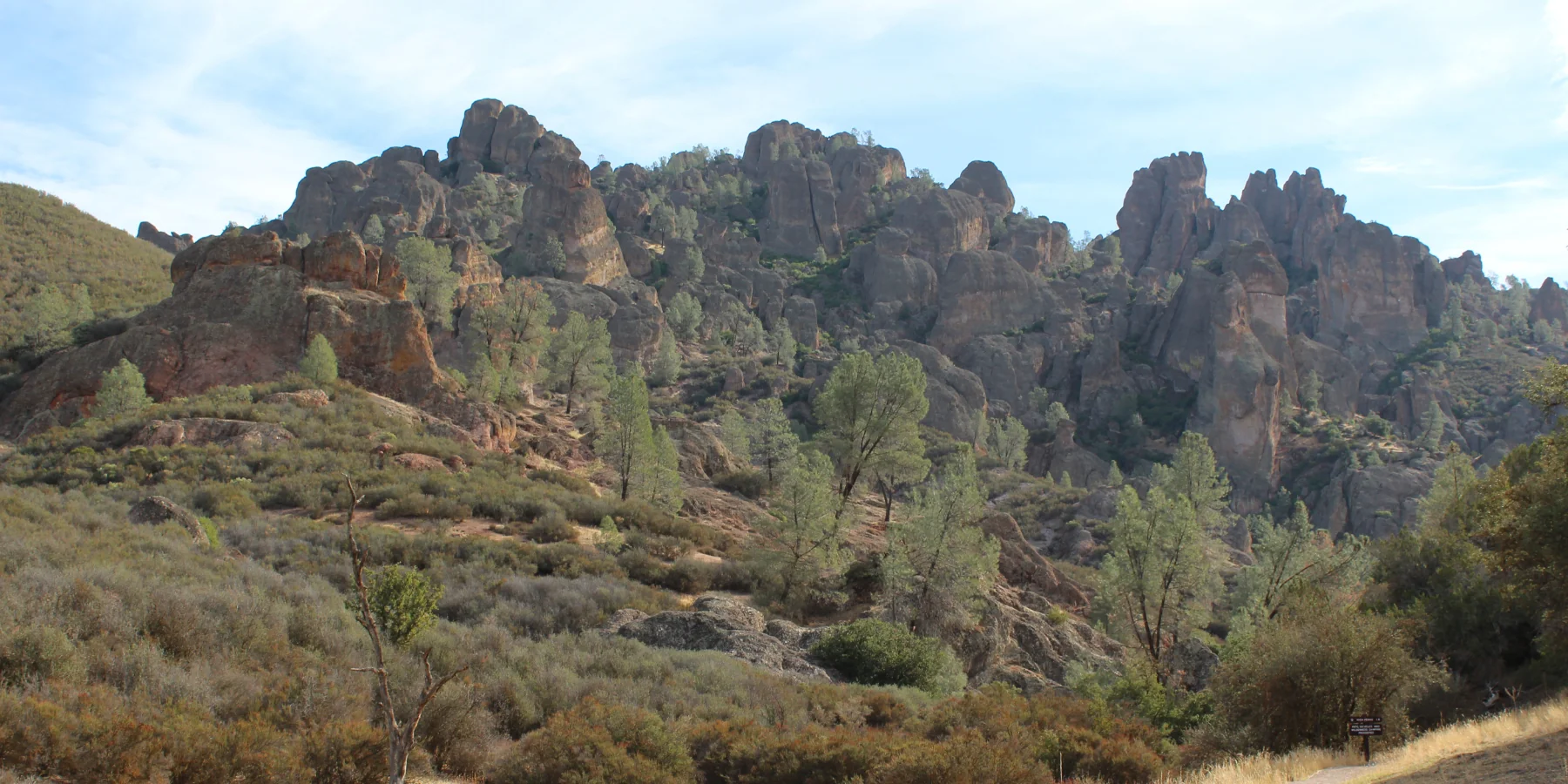
Pinnacles National Park: Thousands of Bats Under the Rocks
Episode 002
13 minutes
Listen to this episode
Also available on:
Episode Description
Bats may not be everyone's favorite animal, but they play a vital role in nature. Without bats, our world would be incredibly buggy. Pinnacles National Park is home to 14 species of bats and they call the super cool talus caves home sweet home. Tune in to learn about how cool bats actually are, what echolocation really is, the secret arms race that plays out in the dark of the night, why we need bats and what we can do to keep them safe.
Resources & Links
Never Miss an Episode
Get notified when we release new episodes
Join our community of nature lovers and curious kids!
Episode Transcript
National Park Scouts · Pinnacles Series · Episode 2
Bat Echolocation & Pinnacles National Park
Host: Jenni · Topic: Bats, talus caves, echolocation
Intro
You heard that sound in our last episode - bat echolocation. The sound of a bat painting a picture of the world with clicks. Today, we are going into the dark. We are gonna find out what echolocation actually is, how it works, and why it's one of the most extraordinary things. We will talk about what it is like to stand inside a cave at Pinnacles with several hundred bats hanging just above your head. Ready? Headlamps on, let's go!
Welcome to National Park Scouts. I'm Jenni, and today we are investigating Pinnacles National Park in Central California. This is episode two of our Pinnacles series. Last time we talked about how the rocks here started life as a volcano 195 miles away, how they were dragged north by the San Andreas Fault over millions of years, and how when those rocks fractured and boulders tumbled into the canyons, they created something pretty rare: talus caves.
Today, those caves are home to 14 species of bats. From the tiny California myotis - a bat about the size of a large grape - to the Western mastiff bat, the largest bat in North America, with a wingspan nearly as wide as a large pizza.
Today we'll mostly talk about the Townsend's big-eared bat, because like the rare talus caves, that bat is rare too. The Townsend's bat has the largest known colony between San Francisco and the Mexican border, right here inside Bear Gulch Cave at Pinnacles.
Bat basics
Bats are mammals, just like us, just like dogs, just like cats. They are warm-blooded, they breathe air, and they feed their babies milk. But they are the only mammals on Earth that have evolved to truly fly - not glide like a flying squirrel, actually fly under their own power with wings.
A bat's wing is actually a hand. If you look at a bat wing up close, you can see the same basic structure as your own hand: a thumb, four fingers, and a thin membrane of skin stretched between them. That membrane is called a patagium; it's one of the most flexible, responsive flight surfaces in nature.
Here is something that surprises almost everyone about bats: they live a very long time for their size. Most small mammals like mice live one or two years. But bats - the Townsend's big-eared bats that live right here in Bear Gulch Cave - have an average lifespan of 16 years. Some bats have lived past 30. For an animal that weighs less than half an ounce, that's kind of crazy.
And bats are not flying mice. They are actually more closely related to primates - like a monkey - than they are to rodents. Most people think bats are blind, but they are absolutely not. Bats have good eyesight; some can see better than humans in low light.
How echolocation works
Echolocation means finding your way with sound. Here is how it works: a bat opens its mouth, vibrates its nose, and sends out a burst of sound. That sound travels out into the dark and bounces off everything it hits - walls, boulders, a flying moth, another bat, the surface of a stream. The echo comes back to the bat's ears, and the bat's brain reads it almost instantly.
From that echo, a bat can tell the size of an object, its shape, its texture, how far away it is, what direction it's moving, and how fast - in complete darkness, at speeds most of us cannot even imagine.
The Townsend's big-eared bat has ears that are nearly as long as its entire body. When the bat is flying and hunting, they extend forward and work like satellite dishes, picking up every bounce and echo.
The bat vs. moth arms race
The Townsend's big-eared bat mostly eats moths. Some moths have evolved ears specifically to hear bat echolocation calls - when a moth hears a bat coming, it can try to evade. Some moths can even produce their own sounds to jam the bat's sonar.
So the Townsend's big-eared bat adapted: it echolocates at a lower intensity than most bats. It's like they're whispering - flying quietly enough that some moths can't hear them coming until it's too late. The bat learned to whisper so the moth couldn't hear it coming. The moth learned to jam signals so the bat couldn't find it. This has been going on for millions of years, and neither of them has won. Respect to both of them.
The maternity colony
The colony inside Bear Gulch Cave is a maternity colony. That means every spring, the females gather together to have their pups and raise them. Each female bat has just one pup every year. The pup is born and can't fly - it's completely dependent on its mother. The mother feeds it milk, keeps it warm, and teaches it everything it needs to know. By mid-summer, the pup is learning to fly and hunt on its own.
During the season when the bats have their babies - mid-May to mid-July - the entire Bear Gulch Cave closes to visitors. Not because the rangers want to keep people out, but because if humans go in at the wrong time, the bats might abandon their roost. And if that happens, the pups don't survive. So if you show up at Pinnacles in June and the cave is closed, that just means lots of bat moms are in there doing the most important thing they do all year.
Bats & the ecosystem
Scout joke
Why don't bats ever feel lonely? Because they always hang out together.
All 14 kinds of bats at Pinnacles eat bugs - every single night. A single bat can eat thousands of insects in just a few hours of hunting. Multiply that by hundreds of bats every night for the entire warm season. Bats are one of the most important bug controllers on the planet.
At Pinnacles, with over 400 species of bees, 500 different types of moths, and thousands of other bugs, bats are a critical part of keeping the whole system balanced. They eat the insects that would otherwise multiply out of control; their droppings - called guano - fertilize the cave floor and feed other small organisms in the cave ecosystem.
Pull the bats out of Pinnacles, and the park changes. The insects change, the plants change, the whole web shifts.
Unfortunately, some bats are in danger of a sickness called white nose syndrome. If you ever visit a cave, be sure to clean your shoes and gear afterward to prevent spreading it. The bats at Pinnacles are currently safe, and rangers and scientists are working to keep it that way.
Wildcard: bat battle
Who is more maneuverable in the air - a bat or a hummingbird?
The bat. Hummingbirds are incredible fliers, but bats can make sharper turns at higher speeds, especially in tight cave passages.
What flies faster - a bat or a professional baseball pitch?
The bat. A typical professional pitch is about 95 mph. The Mexican free-tailed bat has been clocked at 100 mph.
Who eats more insects in a night - a bat or a frog?
The bat, and it's not even close. A frog might eat a few dozen insects in a night, but a nursing bat can eat close to her own body weight in insects.
Answer: how many bat species in the US?
There are 47 species of bats in the United States.
Scout mission
Your mission
Tonight or tomorrow evening, go outside about 20 minutes after sunset and look up. Watch for bats - they fly fast and jerkily, which is different from birds. Count how many you see and watch what they're doing. Are they flying low over water? Circling around a streetlight? Following the edge of a tree line? Every one of those behaviors is a hunting strategy.
If you can't see bats at dusk, try a bat detector app - search "bat detector app." It converts echolocation calls into sounds you can hear.
If you ever visit Pinnacles, plan to be at Bear Gulch Cave around sunset. What you might see coming out of that cave entrance is something you will not forget.
Outro
I'm Jenni. Thanks for joining us at National Park Scouts. If you have a question, a story, an idea, or even a request for a national park to cover, visit nationalparkscouts.com. Our next episode is another fun segment on Pinnacles - come join us again. Scouts, your next adventure is waiting.