Pinnacles National Park: California Condors Back from the Edge
Episode 004
16 minutes
Also available on:
Episode Description
The biggest land bird in North America swoops in for this episode today. The California Condor is not only the largest, it boasts a dramatic comeback story that you don't want to miss. Learn how this big bird owned the skies before the westward expansion, how they almost disappeared, and how Pinnacles National Park is central to their recovery today. You'll learn a few surprising things about the California Condor from their personality to their integral role in the health of the landscape.
Resources & Links
Never Miss an Episode
Get notified when we release new episodes
Join our community of nature lovers and curious kids!
Episode Transcript
The California Condor - A Bird That Almost Vanished
Host: Jenni · Topic: California condors, extinction, recovery
Intro
Have you seen a giant bird before? Not like a hawk. I mean a bird that makes you wonder if it's from the time of the dinosaurs. Something really big. A bird whose shadow is bigger than you. A bird that rides the wind like it owns the whole sky. And it does, kind of - because what just flew over your head has a wingspan of nine and a half feet.
Well, this type of bird exists, and it is called a California condor - the largest flying land bird in North America. Today we're going to learn about these amazing birds and why Pinnacles National Park is their perfect home.
Welcome to National Park Scouts. I'm Jenni, and this is the last episode of our Pinnacles National Park series - for now. We have gone underground through the talus caves. We have stood in Bear Gulch at dusk and watched bats pour out of the cave entrance. We have learned about bees, the ladybug migration, and two insects that exist nowhere else on Earth. And now we're looking up.
Condor basics
The California condor has been soaring over these rocks for thousands of years. It almost went extinct in our lifetimes - and then it came back.
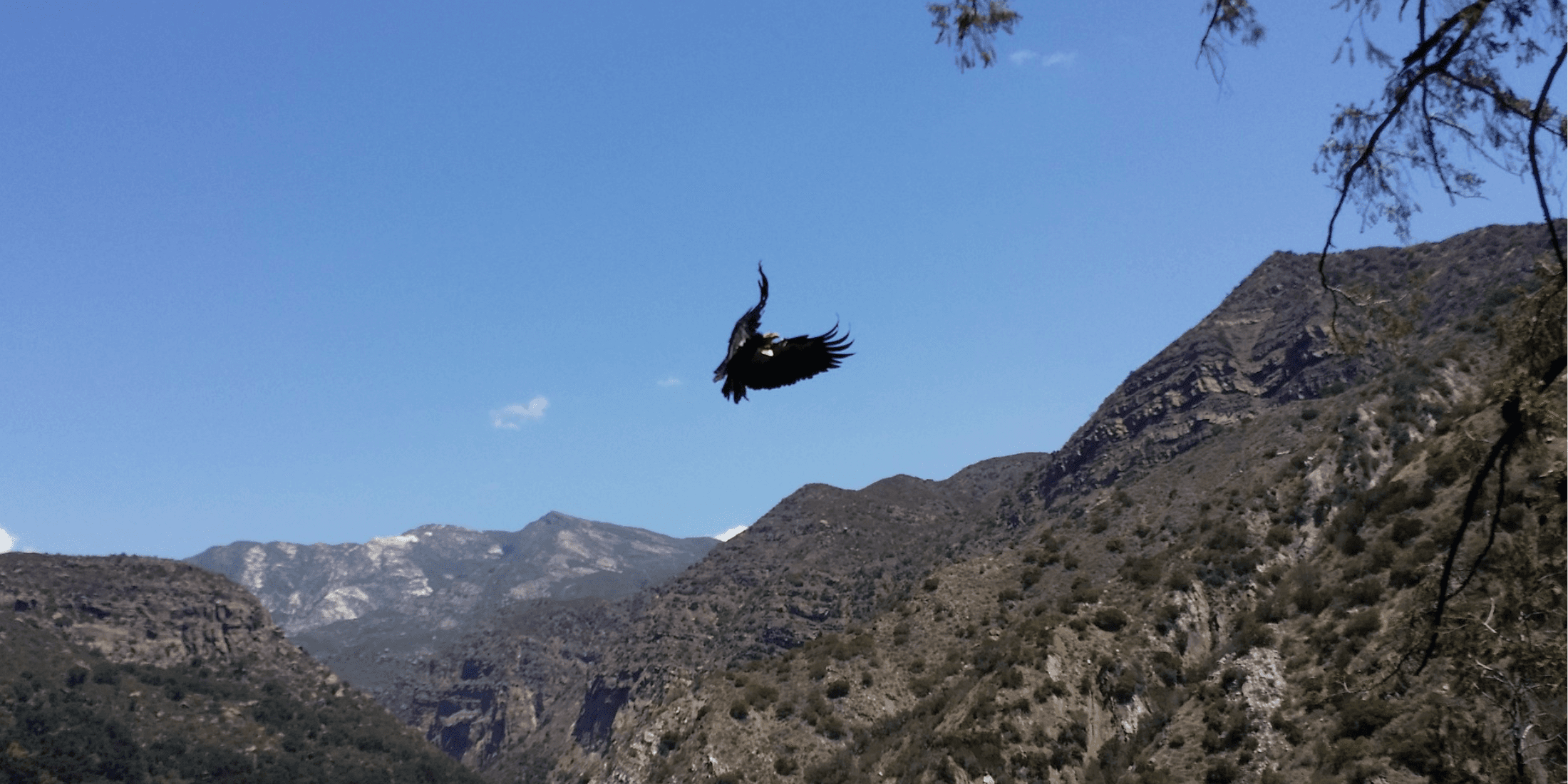
A condor's wingspan is 9.5 feet and it weighs up to 25 pounds. Condors have mostly black feathers, but their head is bald. When their wings are extended, the underside has a strip of white feathers - so if you're out at Pinnacles, now you know what to look for.
Condors soar on warm air currents called thermals - rising columns of warm air that lift them high into the sky. The condor barely flaps its wings; it just tilts and rides. A condor can fly up to 200 miles in a single day without working very hard at all. Kind of like a warm air elevator.
Here's a part that surprises people: condors are playful and smart. Rangers at Pinnacles describe them gathering in groups to inspect new things they've never seen before - like a piece of gear left on a trail. They investigate together the way a group of curious kids might. They play fight, and they spend a lot of time preening each other; sitting still while a friend carefully tends to their feathers.
What condors eat - and why it matters
Condors eat dead animals. Yuck, right? But this is actually a very important job in nature. Condors are scavengers - they do not hunt live animals. Any animal: deer, elk, pigs, ground squirrels. They aren't picky.
Here's why that matters. Dead animals left on the landscape carry bad bacteria and diseases that can spread to other animals or even to water sources. Condors have incredibly sharp eyesight and can spot food from thousands of feet in the air. They find carcasses quickly and remove them from the land before bacteria spreads and makes other animals sick.
Scientists have a word for animals that play this important role: a keystone species - like the keystone in an arch. It's one piece that holds everything else together. Pull it out and the whole structure weakens. The condor isn't just a big, impressive bird; it's infrastructure.
Brain break - condor sounds
Condors don't have vocal cords like singing birds - which is why they sound so unusual. Adults make grunting and hissing sounds, usually when defending their nest. Chicks make sounds too, but usually because they want their parents to bring them more food.
From 22 California Condors to 600 - the recovery story
For thousands of years, condors soared across a range that stretched from British Columbia all the way down to Baja California. There were thousands of them. Then, as settlers moved westward, condors started disappearing. Their habitat shrank as land was developed; gold miners shot them for their feathers; and lead bullets used by hunters poisoned them when condors ate the remains of hunted animals. (Lead bullets are now banned in California, though some people still use them.)
In 1967, the California condor was listed as endangered. In 1982, scientists counted just 22 condors left in the entire world.
Scientists and the U.S. Fish and Wildlife Service made a controversial decision: capture every single remaining wild condor and bring them all into captivity. No condors left in the wild at all. A lot of people were upset - it felt extreme, it felt like giving up on the wild. But scientists believed it was the only way to save the species.
In captivity, researchers would take each egg after it was laid, keep it warm and safe, and when it hatched, feed the chick using a puppet that looked like a condor head - so the chick wouldn't bond with humans. The cycle kept going and the population grew much faster than it could in the wild.
In 1992, the first captive-bred condors were released back into the wild. Today there are just over 600. The population is still fragile, but it's growing. Pinnacles National Park is an active release site; chicks are now being born in the wild too. The flock that lives at Pinnacles has about 98 condors, and biologists track every single one - sometimes rappelling into cliff nests just to check on the chicks.
The rocks that started this series - these ancient volcanic spires that traveled 200 miles over 23 million years - are home to some of the rarest birds on Earth.
Wildcard: condor true or false
True or false: a California condor can fly 200 miles in a single day.
True. They use almost no effort because they ride those warm air currents called thermals. They basically figured out free travel and have been doing it for thousands of years.
True or false: a condor lays one egg every two years.
True. Condor parents spend a whole year raising a chick to adulthood - which is a big reason why the population has taken so long to bounce back. Most other birds have several eggs every year.
True or false: condors build elaborate nests out of sticks and leaves like most other big birds.
False. Condors don't build nests at all. They find a natural cavity - a crack in a cliff, a hollow in a large redwood tree - and lay their egg directly on the rock or wood inside. No nest materials, no decorating. Just a good hole. That'll do.
Scout question of the day
From Grant, age 8
"Why do condors have no feathers on their heads? Most other birds I see have feathers on their heads, but condors don't."
Great question! Condors eat by reaching their heads deep inside dead animals to get to the food inside. If they had feathers on their heads, those feathers would get dirty and wet and stay that way - causing infections and making the bird sick. Bare skin dries quickly and is much easier to keep clean.
Bonus fact: a condor's head actually changes color depending on how it's feeling. If it's excited or agitated, the skin goes bright orange or red. If it's calm, it's more yellowish or pale. Their whole mood is written on their face, in color - which is either very convenient or very embarrassing, depending on how you look at it.
And the lifespan answer we teased at the start: condors can live to 60 years - and scientists think they might live even longer. Most backyard birds live only five to ten years.
Scout mission
Your mission
Go outside and look up. Try laying in the grass or on a trampoline and spend five minutes watching the sky. What is the biggest flying thing you can see? Is it a hawk? A crow? Notice how it moves - does it flap its wings constantly or does it soar?
If you visit Pinnacles, the best places to see condors are the high peaks and rocky, elevated trails on the east side of the park. Early morning is the best time, before the thermals fully develop, when condors are still near their roosts. Bring binoculars if you have them and look for the wing tag on each bird.
Series outro
And that's it for our Pinnacles series. We have gone underground through caves made of falling boulders. We've watched bats paint pictures of the world with sound. We have met 500 species of bees and the tiny beetles that keep the streams clean. And we have looked up at the sky and found an enormous bird that keeps the park clean.
Pinnacles is 42 square miles. Most people drive right past it on their way to somewhere more famous. Now you know what they're missing.
Come back to learn more about our amazing national parks. If you have a question or a suggestion, we'd love to hear from you. Check out nationalparkscouts.com for coloring pages and activities for your next park adventure. Thanks for listening. Scouts, your next adventure is waiting.