Listen to this episode
Also available on:
Episode Description
Did you know scientists study the insects at every National Park? Pinnacles National Park is home to more different types of bees per square acre than almost anywhere else on earth. What?! After bees, we talk lady bug migrations (yes it's a thing) and then two different bugs that live almost no where else. Who knew teeny tiny bugs could be so interesting? Listen with the whole family to learn about one of the most bee-diverse areas, millions of ladybugs, water quality meter bugs and more, all at Pinnacles National Park.
Resources & Links
Never Miss an Episode
Get notified when we release new episodes
Join our community of nature lovers and curious kids!
Episode Transcript
Bees, Ladybugs & the Bugs That Hold It All Together
Host: Jenni · Topic: Bees, ladybugs, endemic insects, ecosystem
Intro
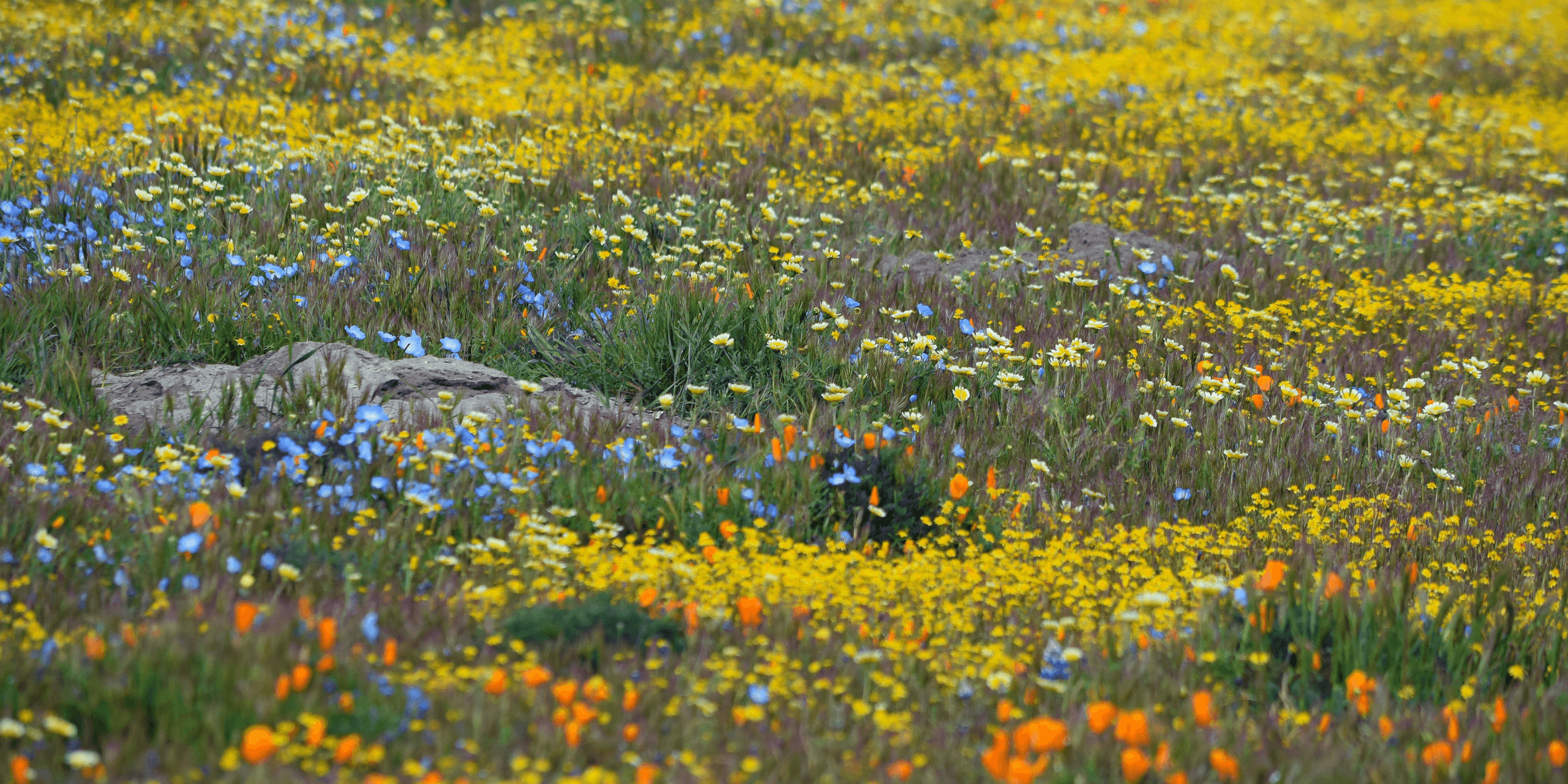
Picture this. You're hiking a trail in California. It's spring. The hillsides are covered in wildflowers - orange poppies, purple lupine, yellow mustard, as far as you can see. And the whole place is humming. Not loudly. Just this low, warm, happy hum that seems to come from everywhere at once. From the flowers, from the rocks, from the air itself. That hum? That's nearly 500 species of bees doing their job.
Today we're gonna find out what that job actually is, and why the wildflowers, the birds, the bats, and almost everything else you can see in this park depends on it.
Welcome to National Park Scouts. I'm Jenni, and this is the show where we explore the wildest, most wonderful places in America's national parks. We have been spending time at Pinnacles National Park - a park in California that most people have never heard of. But scientists, researchers, and anyone who has ever hiked there will tell you it is one of the most fascinating places.
In episode one, we learned that the very ground of Pinnacles was once a volcano that traveled almost 200 miles to get here - carried on a moving slab of Earth's crust. In episode two, we met the bats, including the Townsend's big-eared bat colony in Bear Gulch Cave. Today, we're going smaller. Much, much smaller. Today, we're talking about bugs.
The bees of Pinnacles
Researchers have been studying the bees at Pinnacles for decades, surveying them every couple of years, and every time they come back, they find more species. The current count is almost 500 species of bees living in the park's 42 square miles. The National Park website says Pinnacles has bee diversity that ranks among the highest known anywhere on earth.
Along just one trail - the old Pinnacles Trail, which is only two and a half miles long - researchers have spotted over 260 different kinds of bees.
When you think of a bee, you probably picture a yellow and black striped bumblebee or honeybee. But those two types are actually less than 2% of the bees here. The bees at Pinnacles range in size from as tiny as a sesame seed to as big as an almond. They can be black, brown, bronze, metallic green, metallic blue, or yellow and black striped. Some are fuzzy, some are shiny; some build nests underground, and some nest in wood or plant stems. Some of them live alone.
And here is one of the most surprising facts: about one in six bee species at Pinnacles don't gather pollen at all. Instead, they sneak their eggs into other bees' nests, so their babies hatch and eat the pollen that another bee collected. Scientists call them cleptoparasites - which is a scientific word that basically means sneaky bee thieves.
So why does Pinnacles have so many bee species? The short answer is the bees share. They take their turns in active seasons - one species is out in February, another in April, another in July - meaning many different types of bees can use the same space without competing. Some bees only visit one specific flower; others have very particular places where they like to nest. All this adds up to hundreds of species fitting into a small area without getting in each other's way.
Scout joke: What do you call a bee that can't make up its mind? A maybe.
The wildflowers that make Pinnacles so beautiful in the spring exist because of the bees. Over thousands of generations, bees and flowers have shaped each other. Each flower evolved to attract certain pollinators, and the pollinators shaped which flowers thrived. When you see a hillside of California poppies, you're seeing the result of a very long relationship between bees and plants.
Ladybugs
Now I want to tell you about something you might actually be able to see at Pinnacles if you visit at the right time of year: ladybugs. Not one, not a handful - thousands of ladybugs.
The convergent lady beetle makes an annual migration at Pinnacles. In the fall, they leave the warm valleys and lowlands and travel up into the hills and higher elevations of the park to spend the winter. When they arrive, they arrive together - thousands of ladybugs clustering on rocks, leaves, logs, and plants, blanketing surfaces in red and black. If you hike to the right area in winter or early spring, you might find a rock that appears to be moving. You might put your hand out and have 20 ladybugs land on it at once.
Scout joke: Why don't ladybugs play hide and seek? Because they're always spotted.
Scientists are still studying why they gather in such large groups. Some think it's for warmth; others think it's for protection - predators are less likely to eat one individual out of a thousand. Others think it helps them find mates before they scatter in the spring. Maybe it's all three.
In spring, when temperatures warm and aphids become available in the valleys, the ladybugs disperse back down. A single ladybug larva can eat 300 aphids in two weeks; an adult female can eat several thousand aphids in her entire lifetime. Aphids are a major pest that damage plants and crops - ladybugs are one of the most effective natural pest controllers on Earth.
Two bugs found only in Pinnacles National Park
I want to tell you about two special bugs - because these two have a story that is different from every other creature we've talked about at Pinnacles.
The first is called the Pinnacles shield-back katydid. A katydid is a kind of insect related to crickets and grasshoppers; it has long antennae, strong back legs, but no wings. The shield-back katydid is known for a plate-like covering on its back that looks like a shield. And it only lives in Pinnacles National Park - the only place in the whole world.
The second is called the Pinnacles riffle beetle. It lives its entire life underwater, clinging to rocks in fast-moving streams. It eats algae, it feeds the fish, and it does something else scientists find incredibly useful: it tells them whether the water is healthy. Riffle beetles only survive in clean, oxygen-rich streams. If they're there, the water is good. If they disappear, something's gone wrong. A beetle the size of an ant, acting as a living water quality monitor - for free, every single day.
Every other animal in this series - the bats, the condors, even the bees - can be found in many other places. But not these two insects. They only live here. This is just another reason in the long list of reasons why Pinnacles was made into a national park.
Why Bugs Are Important
I want to make a case for bugs - because I think bugs get an unfair reputation.
If you took all the insects out of Pinnacles tomorrow, the whole park would start to fall apart. The bees pollinate the flowers; no bees means no seeds, no fruit, no plants next year. No plants means no habitat for everything else. The ladybugs control the aphids; without them, aphid populations would explode and destroy the plants that everything depends on. The riffle beetle and the hundreds of other small creatures in the streams are part of the food web that feeds fish, which feeds the birds, which keeps the whole system running.
The park is full of moths, butterflies, dragonflies, and creatures so small most visitors walk right past them without a second glance. Every single one of them is holding something together. They are the reason a park like Pinnacles can support condors and bats and deer and foxes and every other creature that gets attention. The bugs are the foundation. Everything else is built on top of them.
Wildcard: bug battle
Who travels farther - a ladybug at Pinnacles or a monarch butterfly?
The monarch butterfly, and it's not even close. A monarch can travel up to 3,000 miles during migration - from Canada all the way to central Mexico. The ladybug's migration at Pinnacles is measured in miles, not thousands. But the ladybug is having a great time and has never heard of the monarch butterfly.
Who has more muscles - a caterpillar or a human?
The caterpillar. A human body has around 650 muscles; a caterpillar has more than 4,000. Most of these are in its body segments, which is why a caterpillar can bend and squeeze through almost anything. You have more brains though, so that's probably a win.
Who's older - bees or dinosaurs?
The bees. Flowering plants and their bee pollinators evolved together before the famous dinosaurs - T-Rex, Triceratops, Velociraptor - all showed up later. Bees watched the dinosaurs come and go, and then kept working.
Scout question of the day
From Ren, age 8
"Are ladybugs actually lucky? And aren't they all girls?"
Two great questions in one! Ladybugs are not all girls - males and females look almost identical, so the name is just a little misleading. As for lucky: if you're a farmer or gardener, a ladybug landing on your plant is good news. A single ladybug can eat up to 50 aphids in one day - and aphids are the tiny bugs that suck the juice right out of plants and can destroy a whole garden. So ladybugs are basically a tiny pest control crew that works for free. The luck thing isn't totally made up; it just has a scientific explanation behind it.
Scout mission
Your mission
This week, go outside and find a bug you don't recognize - something tiny, something you'd normally walk right past. Look at it carefully. Does it have wings? How many legs does it have? What's it doing - is it eating something, building something, looking for something? You don't have to know what it is. The point is to just look. Really look, the way a scientist would.
If you have a parent or guardian nearby, try looking it up together. iNaturalist is a free app that scientists actually use to track where species are showing up across the country.
If you're visiting Pinnacles, find the old Pinnacles Trail on the west side of the park. Walk slowly, look at every flower, and choose one bee to watch for a minute. Look closely at its back legs - some bees pack pollen into little pouches that look like tiny yellow saddlebags.
If you're there in winter or early spring, hike toward higher elevations and look for ladybug clusters. Don't disturb them; just look. That is one of the strangest and most beautiful things you'll ever see in a national park.
Outro
That's it for today's episode of National Park Scouts. Thanks for joining me. I'm Jenni, and next time we're looking up - way, way up - because at Pinnacles, something with a nine-and-a-half-foot wingspan is soaring over the high peaks. Something that almost went extinct. Scouts, your next adventure is waiting.