Pinnacles National Park: A Volcano Broke Apart and Walked Away
Episode 001
14 minutes
Listen to this episode
Also available on:
Episode Description
A volcano erupts. Tectonic plates collide. And somehow, a chunk of California ends up nearly 200 miles from where it started; and it's still moving. In this episode, we explore Pinnacles National Park: its ancient volcanic origins, the San Andreas Fault that slowly carried it north, and the gravity-made talus caves where 14 species of bats call home deep in the dark.
Resources & Links
Never Miss an Episode
Get notified when we release new episodes
Join our community of nature lovers and curious kids!
Episode Transcript
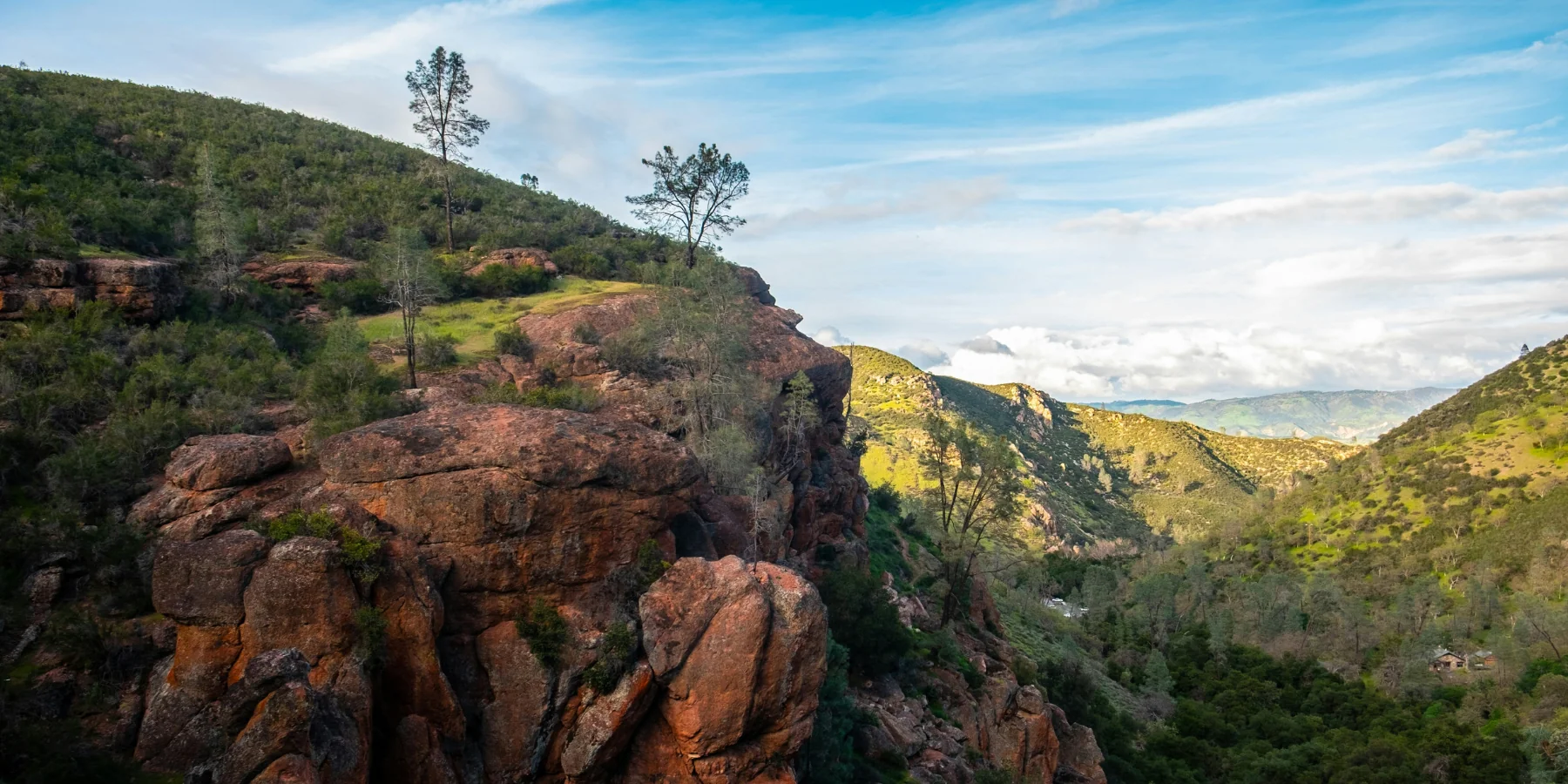
Picture yourself on a trail in California. The sun is warm, the air smells like dry grass and sage, and on both sides of you there are towers of rock - jagged dark volcanic spires jutting straight up into the sky like something out of a movie. You keep walking. The trail narrows, the rock walls get closer, and then the boulders start. Big boulders. House-sized boulders. Stacked on top of each other, wedged against canyon walls. And the trail doesn't go around them - it goes through them.
Welcome to Pinnacles National Park.
Today we are going underground, through caves made by gravity, falling rock, and a volcano that erupted 23 million years ago. And that's just where we're starting.
Pinnacles is in central California, about 80 miles south of San Jose. It became a national park just over 10 years ago, in 2013, making it one of the newest in the entire country. It has towering spires of volcanic rock that look like they belong on another planet, and caves made from boulders stacked on top of each other. Some of these boulders are as big as a house - not a tiny house, not a studio apartment - a real house with a garage and everything. And bats. Fourteen species of bats living inside those caves.
Pinnacles has over 30 miles of hiking trails, from easy walks along the valley floor to steep climbs up to the High Peaks - the rocky ridgeline near the top of the park where the condors like to soar. On a clear day, you can see for miles in every direction. The park has two sides, and it's important to note you can't drive through the middle. The east side, where most families start, has the visitor center, the campground, and the Bear Gulch trail system. The west side is where you'll find Balconies Cave, which is open year-round - it's much darker inside, and if you go in there, plan to get wet.
If you are a rock climber - or just want to watch rock climbers - the volcanic spires at Pinnacles offer routes for every skill level, from complete beginner all the way up to expert. And this whole park exists because of plate tectonics. If you've never heard that term before, we're going to explain it today with a hands-on demo you can try right now, wherever you are listening.
How Pinnacles Got Here
To understand Pinnacles, we have to go back. Way, way back. Millions of years ago in what is now Southern California, near a place we today call Lancaster, there was a volcano. Not like a gentle Hawaiian-style volcano that oozes slow rivers of lava - this was a stratovolcano, like Mount St. Helens; the kind that explodes. It erupted over and over again, sending out thick lava flows and huge blasts of rock and ash that piled up hundreds of feet deep. Over time, that volcanic material hardened into rock - some glassy and smooth, some rough and jagged, some almost fluffy-looking from all the air bubbles trapped inside when it cooled. They all came from the same volcano.
When the eruptions eventually stopped, something else took over: the plates.
The Earth's outer layer - its crust - isn't one solid shell. It's broken up into a dozen massive pieces called tectonic plates, like a cracked hard-boiled egg. These plates are thousands of miles wide, and they're moving very, very slowly - usually about as fast as your fingernail grows - but they never stop.
When plates meet, they can crash head-on and push up mountains, pull apart and create ocean floors, or slide past each other like two cars scraping past each other in a parking lot. That third one is what happens in California, and it's called the San Andreas Fault.
Here's a demo you can try right now. Take both hands, lay them flat with palms down and thumbs touching, fingertips pointing away from you. Now slide your left hand slowly away from you while your right hand stays still. That's basically what the Pacific Plate and the North American Plate are doing. The Pacific Plate is sliding northwest, the North American Plate stays put, and where they grind against each other is the San Andreas Fault - a crack in the earth that runs almost the entire length of California.
When this fault formed, it split right through that ancient volcanic rock formation near Lancaster. Then, very slowly over millions of years, the Pacific Plate dragged one half of that formation north - 195 miles north. Half of a mountain range, picked up and carried almost the whole length of California. The other half is still sitting near Lancaster today; scientists call it the Neenach Volcanic Formation. The rocks match perfectly - same minerals, same age, same eruption. One volcano, two locations nearly 200 miles apart. The half that got moved? That's Pinnacles.
How the Caves Formed
Once the volcanic rock arrived in its new home, the grinding and pressure from millions of years along the fault had cracked it in all directions. Then rain and wind took their turn. The softer rock eroded away first, leaving harder rock standing tall. Over millions of years the landscape was carved into narrow, deep gorges - and then giant boulders started to fall into those canyons and get stuck. They wedged against the canyon walls and stacked on top of each other, never quite falling all the way to the bottom. The space underneath those jammed boulders became the caves. Scientists call them talus caves, and they're formed by gravity, falling rock, and just the luck of a boulder landing at exactly the right angle to get stuck.
There are two main cave systems at Pinnacles: Bear Gulch Cave on the east side, and Balconies Cave on the west. Both have trails running through them - through actual gaps between massive boulders, in the dark, with real bats living inside.
The Wild Card Sound Segment
Now it's time for the Wild Card segment. Three sounds from inside Pinnacles National Park - see if you can guess what's making them.
Sound one is a bat - specifically, the echolocation clicks bats use to navigate in complete darkness. Bats send out sound waves so high-pitched that humans usually can't hear them without special equipment. When the sound bounces back, the bat's brain processes the echo and builds an exact map of its surroundings - every wall, every boulder, every flying insect, in real time. Fourteen species of bats live in Pinnacles' talus caves. The most famous are the Townsend's big-eared bats, named for their giant ears, which are nearly as long as their bodies. The moms come together in a colony to raise their pups in Bear Gulch Cave - and the cave closes to visitors during pupping season, so check the National Park Service website before you visit.
Sound two is from the wings of a California condor - the biggest wild bird in North America, with a wingspan up to nine and a half feet. Most ceilings are only eight feet high, so a condor might not even be able to stretch its wings inside your house. Condors nest in the cliffs and caves of Pinnacles, which is one of the reasons the park is so important.
Sound three is a group of Mexican free-tailed bats leaving a roost at dusk, all at once, in a single spiraling stream. Pinnacles has an incredible abundance of insects, and bats eat insects every single night - a single bat can eat thousands of flying bugs in just a few hours.
Scout Question of the Day
Jackson asks: "If the tectonic plates are still moving, is Pinnacles still moving? Will it end up somewhere different in the future?"
Great question, Jackson - and yes. The San Andreas Fault never stopped moving. The Pacific Plate is sliding northwest roughly two inches per year, about the rate your fingernails grow. Slow, right? But over a million years, that's 31 miles. So Pinnacles is still moving right now, as you listen to this podcast - those rocks are still sliding north, just too slowly to feel.
Here's something extra cool: Pinnacles was actually one of the key pieces of evidence that convinced the scientific world that plate tectonics was real. In the 1950s and 60s, the idea that continents could drift was genuinely controversial - a lot of scientists didn't believe it. Then geologists matched the rocks at Pinnacles to the Neenach Formation in Southern California - same minerals, same age, 200 miles apart - and proved the only explanation was that the ground had moved. This small park in the California hills helped change how we understand our entire planet.
Today, Pinnacles protects 14 species of bats, almost 500 species of bees, and a growing population of California condors - all living inside and around a pile of ancient volcanic rock that has been slowly traveling north for 23 million years.
Your Mission
If you're visiting Pinnacles, find a crack in a boulder or a canyon wall. Look at it closely. Think about what caused it - is it from erosion? From the fault? Is anything living in it; a plant, a bug, a lichen? A crack is a story. See if you can figure it out.
If you're at home, go outside and find any crack in a rock, a sidewalk, a concrete wall, or dry dirt. Same mission: what made it, and what's living in it?
You now know something most adults don't. There's a park in California that started its life 200 miles away - and it's still moving north right now, as you listen. Scouts, your next adventure is waiting.