Great Smoky Mountains National Park: Salamander Capital of the World
Episode 007
23 minutes
Listen to this episode
Also available on:
Episode Description
Salamanders. Did you know that there are so many in the Great Smoky Mountains National Park that scientists have nicknamed it "The Salamander Capital of the World?" Yep, it's true. In this episode, we will find out why the Smokies have so many salamanders - hint: it has to do with how old and wet these mountains are! Next, we will meet two of the parks coolest salamander residents. One is so so big with silly nicknames and the other has a fun trick up it's sleeve. Listen in to learn how to spot these cool creatures on your next park visit.
Resources & Links
Never Miss an Episode
Get notified when we release new episodes
Join our community of nature lovers and curious kids!
Episode Transcript
National Park Scouts
Under Every Log: Salamanders of the Great Smoky Mountains
Host: Jenni · Topic: Salamanders, lungless wonders, ice age refuges, endemic species
Intro
Picture this
You're outside. It just rained - you can smell it. That clean, wet smell that comes right after a rainstorm. You're standing at the edge of a clear, shallow stream. The water moves slowly over smooth stones, and you can see all the way to the bottom. You crouch down to get a closer look. And then you see something move. Not in the water exactly - at the edge, where the wet bank meets the stream. Something small, low to the ground. Four tiny legs, a long tail, smooth dark skin. It stops. You stop. You both stay completely still for a moment, and then it slips into the water and disappears between two rocks, gone before you could even get a good look.
You lean in closer. You wait. There's another one. And another. Once you know what you're looking for, they're everywhere.
Now, what if I told you that in one very specific place on Earth, every stream, every wet bank, every mossy boulder - this would happen every single time? More salamanders than you could ever count, packed into one mountain forest. So many that scientists gave it a nickname.
Welcome to National Park Scouts. I'm Jenny, and this is a show where curious kids discover America's wildest places. We are still in the Great Smoky Mountains, still finding things most people walk right past. We've found what makes all that smokier mist. We've gazed at the fireflies. And that brings us to today. Today, we're going underground, underwater, and under every log we can find. Let's go find some salamanders.
Not a lizard
Salamanders vs. lizards: the difference matters
A lot of people see a salamander and think: lizard. Understandable. Four legs, a tail, moves fast, lives in the woods. But salamanders and lizards are about as different as you can get while still both having four legs.
Lizards are reptiles. Dry, scaly skin. Leathery-shelled eggs. They like it warm and sunny. Salamanders are amphibians. Their skin is smooth and moist - sometimes slimy. They cannot dry out. They need moisture, shade, cool temperatures, and water nearby. A salamander basking on a warm, dry rock would be a salamander in serious trouble.
Locals in the Appalachian Mountains have called salamanders "spring lizards" for generations - a charming name, but scientifically not a lizard. Salamanders are actually much more closely related to frogs and toads. They're ancient - the salamander family has been around for about 160 million years. They were here when the dinosaurs were here. They outlasted the dinosaurs. They'll probably outlast a lot of things.
The salamander capital
Why does this one park hold so many?
In 1998, scientists launched the All Taxa Biodiversity Inventory - the ATBI for short. The idea was simple: count every living thing in the park. Every plant, every insect, every fungus, every worm, every salamander. After over 25 years of careful, muddy field work, scientists counted more than 30 species of salamanders living here. That number is impressive enough that they gave this park a nickname: the Salamander Capital of the World. Not the bear capital. Not the waterfall capital. The salamander capital.
The ice age connection
About 20,000 years ago, massive glaciers crept southward across North America. They didn't quite reach the Smoky Mountains, but they got close. As the glaciers pushed south, all the animals and plants in their path had to move - spreading ahead of the ice. The Appalachian Mountains became a refuge, a place where species from the colder north could survive.
When the glaciers melted, many of those animals stayed. Over thousands of years, isolated in different valleys and at different elevations, they evolved separately. One original species would split into two, then four, then more - each slightly different, each adapted to its own corner of these mountains. Everything connects: the ancient mountains, the ice age, the moisture, the undisturbed wilderness. And salamanders - cold, wet, built exactly for this environment - flourished.
Lungless salamanders
No lungs - and doing just fine
Here's where things get truly strange. Of the more than 30 salamander species in the Great Smoky Mountains, 24 of them - nearly all of them - have no lungs. None. Scientists call them lungless salamanders, which is admirably straightforward naming. Their scientific family name is plethodontidae, which sounds impressive at dinner parties.
So how do they breathe? Through their skin. Oxygen from the air or water seeps directly through the skin and into tiny blood vessels just underneath. Carbon dioxide seeps back out the same way. The salamander's entire body surface is a breathing organ - every single inch of skin, working all the time.
This is why they need to stay moist. If the skin dries out, the gas exchange stops. A lungless salamander that dries out completely cannot breathe. This is also why you find them under logs, under rocks, in streambeds, in leaf litter - anywhere that's cool and damp. They're not just hiding. They're keeping their skin working.
Brain break - the barred owl
Jenny played a recording of a barred owl. People who love birds have been saying this for a long time: the barred owl sounds like it's asking a question. Try saying this out loud with the rhythm of the hoots:
"Who cooks for you? Who cooks for you all?"
Barred owls call year-round, day and night. If you imitate that call in the woods, one might call right back - they're territorial and want to know who's in their forest.
The hellbender
A living relic - 65 million years and counting
Within the salamander world of the Smokies, one species deserves its own moment: the hellbender. North America's largest salamander. It can grow up to 29 inches long - about the size of a skateboard. It weighs up to five and a half pounds, and it's fully aquatic, living entirely underwater, almost never coming out. It has a broad, flat head, a long paddle-shaped tail, and loose folds of wrinkled skin running down its sides.
Hellbenders have been living in the rivers of the eastern United States for about 65 million years. The dinosaurs may have disappeared, but the hellbender stayed.
Nicknames collected over the years
People have given the hellbender a remarkable collection of nicknames over time: Snot Otter, Devil Dog, and Lasagna Lizard - which is especially silly because it's actually a very gentle creature, shy and hidden during the day.
The hellbender technically does have lungs, but it almost never uses them. It breathes almost entirely through those wrinkled skin folds, which increase its surface area - more skin in contact with oxygen-rich water, more breathing. A scientist once surgically removed a hellbender's lungs just to see what would happen. The hellbender was completely fine. It continued living normally, as if nothing had changed. Those lungs were so unnecessary that their absence made no difference whatsoever.
The Jordan salamander
Small, toxic, and impossible to eat
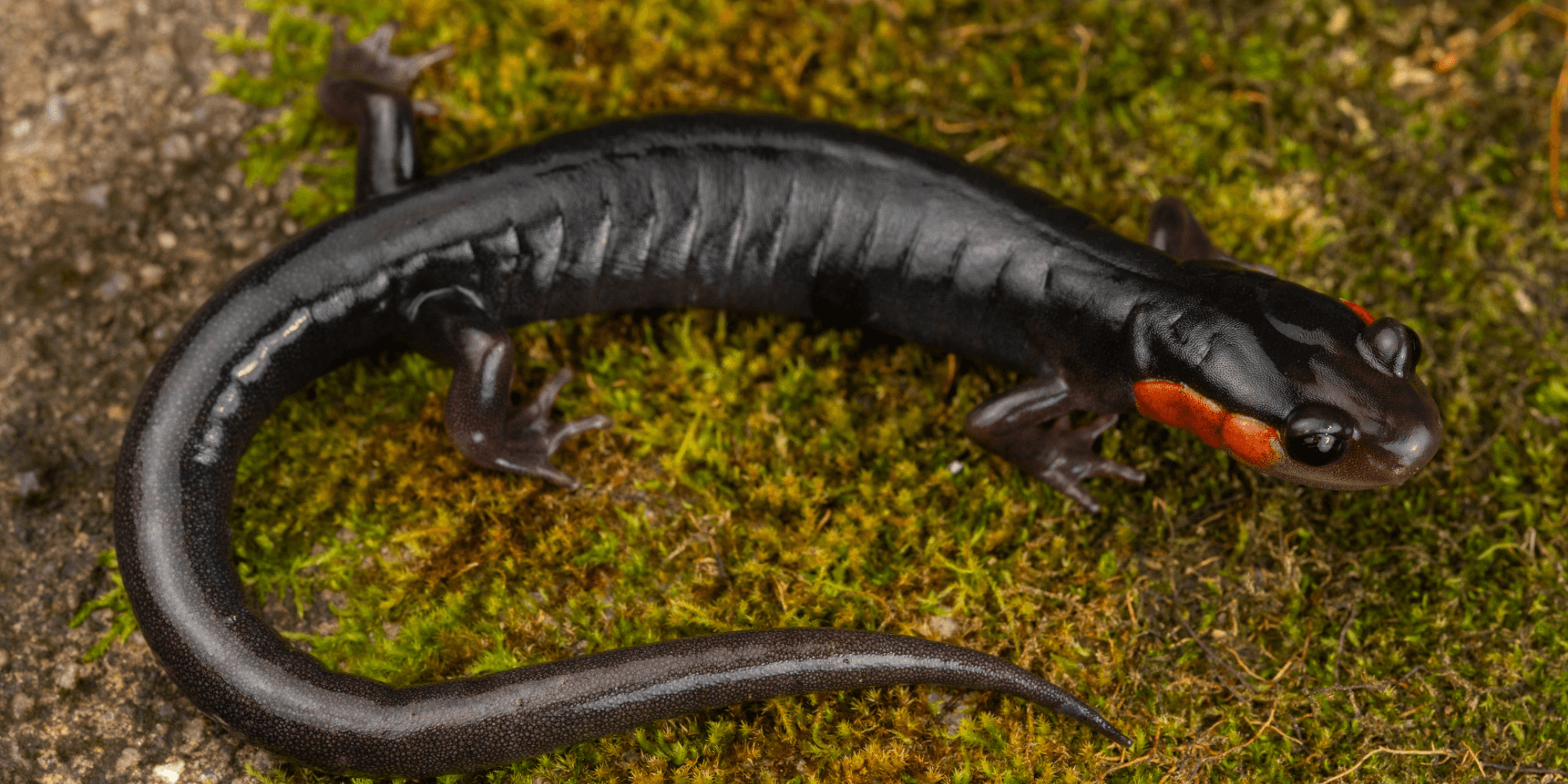
The Jordan salamander is almost the opposite of the hellbender. Small - only three to five inches long - and it has a very distinctive feature: bright red or orange patches on its cheeks, like tiny painted flames on the sides of its face. Those cheeks are not decoration. They're a warning.
The Jordan salamander has toxic secretions in its skin - chemicals that taste absolutely terrible to anything that tries to eat it. The red cheeks are basically a sign that says: try it anyway, and see what happens. Predators learn.
That time a salamander glued a snake's jaw shut
Scientists once watched a garter snake attack a Jordan salamander. The snake grabbed it - and a three-to-five-inch salamander is easy to grab. The salamander produced a thick, sticky mucus; a slime so powerful it glued the snake's jaw shut. The snake couldn't open its mouth, couldn't even move properly. The salamander walked away.
The Jordan salamander lives only in a small corner of the southern Appalachians - mostly in Great Smoky Mountains National Park. Scientists call species like this endemic: it evolved in one specific place and exists almost nowhere else on Earth. Thousands of them are out there right now, under rocks, under logs, wandering the forest floor on rainy nights. Most visitors walk right past them every day without knowing.
Field guide
How to actually find one
Rule one: look where it's damp. Salamanders need moisture. A dry, sunny hillside has almost none. A shady stream bank, a mossy log, a flat rock in a creek - that's where you look.
Rule two: look under things. Salamanders hide. Gently lift the edge of a log and look underneath. The park asks you not to lift rocks in streams, though - that's where some species lay their eggs.
Rule three: if you find one, observe it first. Watch it for 30 seconds. Notice the color, the size, whether it has spots or stripes; does it have visible gills? After you've looked, put everything back exactly as you found it.
In streams, look in clear, shallow water along the edges. And after rain is the best time of all. A warm rainy night in the Smoky Mountain forest is salamander paradise.
Wildcard game
Two truths and a lie
Three statements about salamanders. Two of them are true - one is made up. Which one is the lie?
Statement 1: Salamanders can regrow lost body parts - not just their tails, but some species can regrow their legs, their eyes, and even parts of their heart.
True. Scientists are actively studying this right now because they want to understand whether humans might someday be able to do something similar.
Statement 2: At any given moment, 90% of all the salamanders in a forest are underground. The ones you might actually see are the other 10%.
True. Right now, wherever you are - if there are salamanders nearby - almost all of them are underneath you, hidden, waiting. You just can't see them, which is honestly just how they like it.
Statement 3: If you added up the weight of all the salamanders in the eastern United States, they would weigh more than all the deer.
This is the lie. Statements one and two are both completely true - this one was invented.
Scout question of the day
From Ben, age 8
"If I found a salamander, is it safe to pick it up? Are they dangerous to touch?"
Great question - and the answer has two parts. Part one: most salamanders in the Smokies are completely harmless to pick up briefly. They won't bite, they won't sting. A few species have mild skin secretions that make them taste bad to predators - like the Jordan salamander. If you pick one of those up and then touch your eyes without washing your hands, that could be unpleasant. So: don't touch your face, and wash your hands after.
Here's the more interesting part - part two: you are more dangerous to them than they are to you. Remember how salamanders breathe through their skin? That same skin is incredibly good at absorbing things from the outside world. Your hands - even clean hands - have oils, salts, traces of sunscreen, bug spray, soap residue, and lotion. Things that are completely harmless to you. If a salamander absorbs those things through its skin, it could hurt the salamander. The real rule isn't "be careful because they might hurt you." The real rule is "be careful because you might hurt them."
Scout mission
Your mission this week
After the next rain, go outside and look under a log, a flat rock, or a piece of bark in a shaded, damp spot. Do it gently - slide it to the side, don't flip it. See what's living there. You might find a salamander, a worm, a pillbug, a centipede, or a beetle. All of them are part of the same underground world. Look for 30 seconds, then put everything back exactly as you found it.
If you're visiting the Great Smoky Mountains, find a clear, shallow stream. Look in the water along the edges and watch the bottom carefully. You might spot one moving - without disturbing anything at all.
Bonus challenge for both: try to describe what you found to someone. Color, size, any markings, whether it had gills. That is called field science.
Outro
What you learned today that most adults don't know
A scientist once surgically removed a hellbender's lungs - and the hellbender was completely fine. It kept living, it kept breathing through its skin, exactly as it had been doing all along. Those lungs were so unnecessary that their absence made no difference. Twenty-four of the salamander species in the Great Smoky Mountains have no lungs at all. They breathe entirely through their skin, every moment of every day. And the one species that does have lungs? Doesn't really use them anyway.
That's our episode, scouts. We found out what a salamander actually is - and why it's definitely not a lizard. We found out why the Smokies have more salamander species than anywhere else on Earth. We met the hellbender, the biggest salamander around, and we found the Jordan salamander, which lives only here. Not bad for something most people walk right past.
Next time, we're done being quiet, done being small, and done looking under logs - because episode four is about the animal that has been the symbol of this park since the very beginning. The one that stops traffic. The one scientists call the most famous resident of the Great Smoky Mountains. The black bear is next. Scouts, your next adventure is waiting.