Listen to this episode
Also available on:
Episode Description
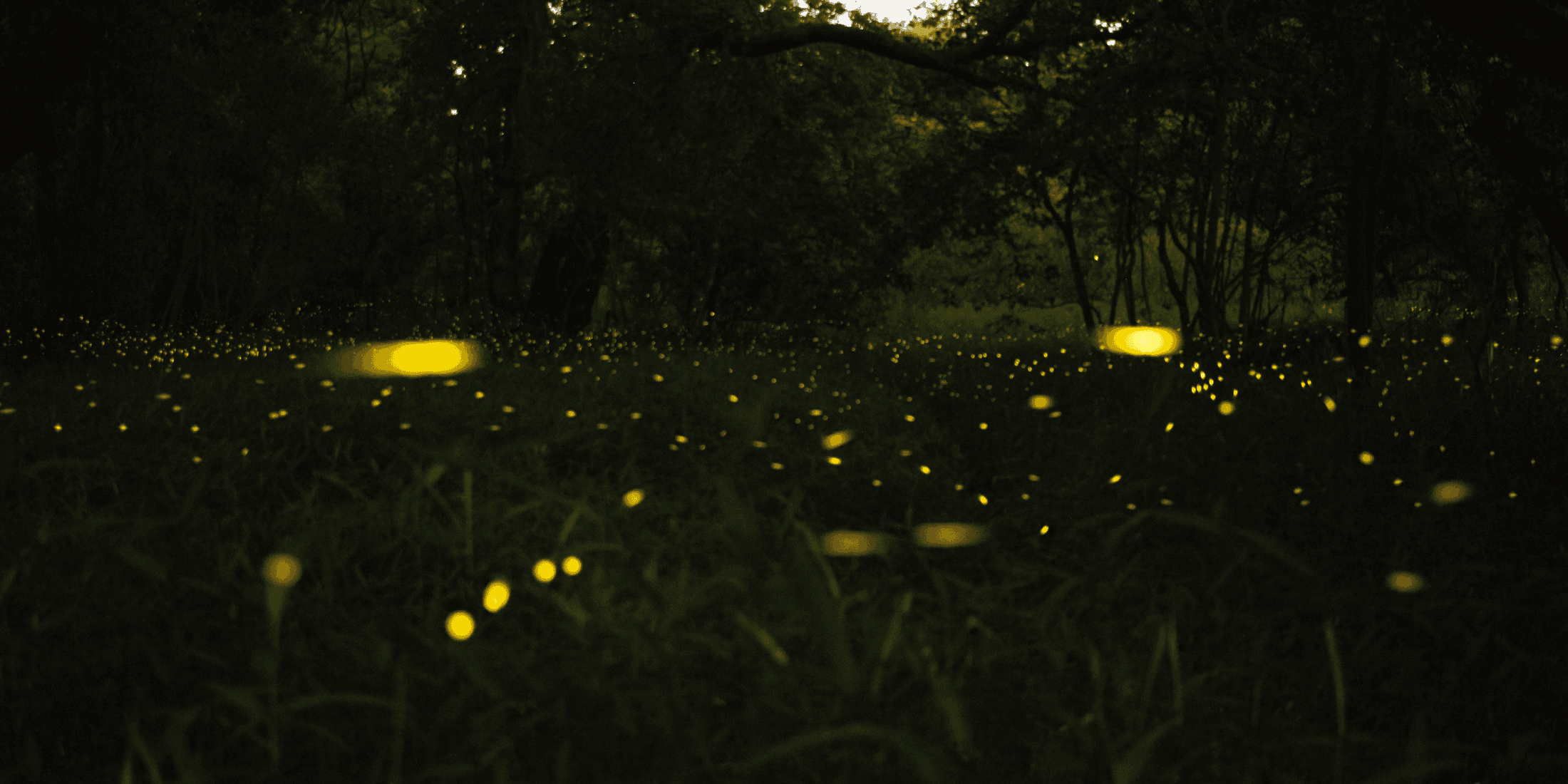
Today, we explore the Smokies at night. Magical flashing fireflies light up the Great Smoky Mountains National Park all summer. However, only one species synchronizes to produce the largest show in the entire world! Learn how fireflies make their light, why they're different colors, and why they light up different parts of the night.
Can you guess this week's park sound? It's a hard one.
Resources & Links
Never Miss an Episode
Get notified when we release new episodes
Join our community of nature lovers and curious kids!
Episode Transcript
National Park Scouts
Synchronous Fireflies
Host: Jenny · Location: Great Smoky Mountains, Tennessee & North Carolina
Intro
The lottery that leads to the woods
Every year, thousands of people enter a lottery. They fill out a form, they pay a dollar to apply. They wait. And then, if they're one of the lucky ones, they get an email. They've been selected. And then they drive to a campground in Tennessee at night and they walk into the woods to watch bugs. Very specific bugs. Very specific woods. Very specific night.
But here's the thing. Everyone who wins that lottery - every single person who has made that drive and walked into those woods - says it's one of the most incredible things they've ever seen in their lives. Scientists once said this was impossible. A woman who had been watching since she was a child had to write a letter to prove them wrong. Today, we're going to find out just what she saw.
Welcome to National Park Scouts, the show where curious kids discover America's wildest places. I'm Jenny, and today we are still in the Great Smoky Mountains, still in Tennessee, in North Carolina, still surrounded by acres and acres of forests. But tonight we're doing something different. We're going out after dark. This is the episode about synchronous fireflies. And I promise you, by the time we're done, you're going to understand exactly why thousands of people enter a lottery every year just to stand in the woods at night. Let's go.
Fireflies 101
They're actually beetles
First things first: fireflies. You might know them as lightning bugs. You might have caught them in a jar on a summer night. Either way, here's something that might surprise you. Fireflies are not flies. They're beetles - full-on beetles in the same insect family as ladybugs and dung beetles. The name "firefly" is just what people started calling them because of the light. Scientifically: beetle. Totally a beetle. Firefly sounds better though. We'll keep firefly.
There are around 2,000 species of fireflies in the world. They live on every continent except Antarctica, which is probably a little cold for them. In the United States alone, there are more than 150 different types. And in the Great Smoky Mountains National Park, there are 19 species - all living in the same place at the same time. Most of them flash. Males fly around flashing a signal. Every species has its own unique pattern, like a secret code. Females sit on the grass or on leaves and flash back if they like what they see. It's basically the world's most romantic Morse code.
The Science
How fireflies make cold light
Inside a firefly's abdomen - the back part of its body, the segment after the head - there's a special organ called a lantern. And inside that lantern, two chemicals meet each other. The first is called luciferin. The second is an enzyme, a kind of helper molecule, called luciferase. When luciferin and luciferase combine with oxygen, a chemical reaction happens, and that reaction releases energy. But here's the truly remarkable part: the energy doesn't come out as heat. It comes out entirely as light. Scientists call it cold light.
Think about a regular incandescent light bulb for a second. They get really hot, right? They produce light, but most of the energy is just wasted as heat. A firefly's lantern turns nearly 100% of its energy into light. Almost nothing is wasted as heat. Engineers have spent decades trying to build light bulbs that efficient - and a firefly figured it out.
On top of that, the firefly controls its own light switch. It regulates how much oxygen flows into that lantern. More oxygen: light on. Less oxygen: light off. We have been making glow sticks for decades, and they work basically the same way - two chemicals in a tube that react when you bend it and break the barrier between them. A firefly has that built in, and it can turn it on or off at will.
The Synchronous Display
Photinus carolinus - the synchronous species
There are 19 species of fireflies in the Great Smoky Mountains, all flashing at the same time every summer night. So if you're a female firefly sitting on the grass trying to find a male of your own species, this is a problem. There are flashes everywhere. And it gets even more complicated. Some of those fireflies are actually dangerous. There are species where the females have figured out a sneaky trick: they watch the flash pattern of males from a different species, then imitate the female response flash to lure the male over. And when he arrives expecting a date, she eats him. Scientists call them femme fatale fireflies.
So if you're a Photinus carolinus - the synchronous species - you have a serious problem. The woods are full of fakes and competitors. How do you stand out? The answer is: you don't stand out alone. You synchronize.
As dusk falls over Elkmont in the Great Smoky Mountains, the first few males start flashing. They have a specific pattern: six rapid flashes in quick succession, then six seconds of complete darkness, then six flashes again - over and over. The whole forest pulses with light, then goes completely black, then lights up again every six seconds, like a giant switch being thrown across an entire hillside. Witnesses describe it as the forest breathing light.
Why do they do this? That dark period after the flash gives females a quiet moment to pick out a mate without all the other flashes getting in the way. It's like everyone at a party agreeing to go silent for six seconds so two people can actually have a conversation. Out of 2,000 firefly species in the world, only about a dozen can synchronize. Photinus carolinus is one of them, and it produces the largest synchronous firefly display in North America - maybe even the world.
Park Sound
The sound in today's mystery clip was a peregrine falcon - the fastest animal on Earth. Not the fastest bird, but the fastest animal out of all of them, faster than a cheetah. When a peregrine spots prey from high in the sky, it tucks its wings, points its body straight down, and dives. Scientists call this dive a stoop. During a stoop, a peregrine falcon can reach over 200 miles per hour. The bird's body is built exactly for this: tiny bony ridges inside its nostrils act like speed bumps to direct airflow so the pressure doesn't damage its lungs. A third eyelid sweeps across like a windshield wiper mid-dive. They nest right here in the Smokies, up on the cliffs at Inspiration Point on the Alum Cave Trail. We'll have a whole episode on the peregrine falcon soon.
The Lightning Bug Lady
Lynn Faust and the letter that changed science
There is a cabin at Elkmont - a little community of historic vacation cabins right inside the Great Smoky Mountains National Park. A woman named Lynn Faust spent her childhood summers there. Playing in the creek, hiking the trails, and every summer evening, gathering on the porch after dinner to watch the fireflies light up the hillside. She thought everyone knew about it. She thought it was just something fireflies did.
Then in 1991, Lynn Faust was flipping through a copy of Science magazine, and she came across an article about synchronous fireflies in Southeast Asia. In the article, a renowned scientist stated: synchronous fireflies do not exist in the Western Hemisphere. Lynn stared at that sentence. She thought: that's what we've been watching on my porch my whole life. Who do I tell this to? She tracked down the scientist's mailing address. She wrote him a letter. She said, I believe there are synchronous fireflies at Elkmont in the Great Smoky Mountains. Come and see.
So the scientist came. He brought colleagues. They set up their instruments in the dark at Elkmont. And then nothing happened. 9:30 at night. Nothing. The scientists stood in the dark with their equipment. Lynn stood next to them, getting more and more nervous. She was questioning herself - had she imagined this? Had her whole family imagined this for decades? Thirty minutes passed. And then the forest lit up. The scientists started running through the dark with their instruments, crying for joy.
Photinus carolinus was confirmed: the first synchronous firefly species ever documented in North America. Lynn Faust, who was not a scientist, who had just been watching fireflies from a porch, had been right all along. She is now known around the world as the Lightning Bug Lady. She wrote the first ever field guide to fireflies in the eastern United States. She has been one of the world's leading experts on bioluminescent beetles for over 30 years. And it started because she trusted what she had seen with her own eyes and wrote a letter.
How To See Them
The lottery, the rules, and what it's actually like
Every year, the National Park Service announces an eight-day viewing window, usually late May or early June, depending on temperature and soil moisture. The fireflies decide the schedule. The park just follows along. And because so many people want to see it, there's a lottery. You apply on recreation.gov. You pay $1 just to enter. If you're selected, you pay about $30 for a vehicle pass. Only about 120 to 140 cars are allowed in per night, to protect the fireflies and make sure everyone has a good experience. The odds aren't great, but they're not impossible, and people say it's worth entering every single year.
Here's what it's actually like when you go. You arrive at Elkmont before dark. You find your spot along the trail and you wait. The rules are strict and they make sense once you understand them. No white lights - no flashlights, no phone screens. The fireflies use light to communicate, and white light from humans can completely disrupt their flashing patterns. So you bring a red flashlight. The whole viewing area goes dark. And then around 9:30 at night, it starts. A few flashes, then a few more. Then you hear people around you go quiet because the forest is starting to do something.
People describe it as magical, otherworldly. One visitor wrote that it looked like the forest floor was covered in twinkle lights as far as you could see. It lasts for hours. It's worth the lottery.
Life Cycle
Most of their life is underground
Here's something about synchronous fireflies that you wouldn't expect. Photinus carolinus spends most of its life underground. As a larva - the worm-like stage before it gets wings - it lives in the leaf litter and soil of the forest floor for one to two years, hunting snails and worms in the dark, just doing its thing. Then, after all that time underground, it transforms. It gets wings, it emerges into the summer air, and it has about three to four weeks to live. That's it.
Three to four weeks as an adult - as the flashing, flying, show-stopping firefly we came to see. Many of them don't even eat during this time. They live on stored energy from their larval stage. They have one mission and they are completely focused on it.
Other Species
The blue ghost and the big dipper
Photinus carolinus is the famous one - the synchronous one, the one with the lottery. But remember, there are 18 other species of fireflies in the park, all with their own tricks.
There's one called Phausis reticulata, the blue ghost. While Photinus carolinus flashes, blue ghosts glow continuously - no flashing, just a steady, slow-moving light that drifts through the forest like a ghost. They look blue from a distance, which is how they got their name. Up close, their light is actually a pale green, but in the dark of the forest, drifting between the trees with no flashing - just a slow, continuous glow - they look eerie and magical.
There's even a species called the Big Dipper Firefly. It flies in a J-shaped arc while it flashes, dipping down and lighting up at the bottom of the J. Scientists nicknamed it the Big Dipper because of the shape. It's the most common firefly in eastern North America. The Smokies have all of these - 19 species, all telling their different stories in light all through the summer nights.
Scout Question of the Day
Scout Question of the Day
From Quinn, age 12
"Why do some fireflies flash different colors? Why are some yellow and some green?"
So you know how fireflies make light with those two chemicals, luciferin and luciferase? Same chemicals in every firefly. But here's the cool part: the luciferase - the helper molecule - it's shaped a tiny bit differently in each species. And that different shape changes the color of the light that comes out. Think about it like this: you know how a garden hose sprays different shapes depending on how you hold the nozzle? Same water, different nozzle shape, totally different spray. Same idea here: same chemicals, different molecular shape, different color light.
But here's another interesting part - the color actually means something. Fireflies that come out early in the evening, when the sky is still kind of light and everything looks greenish, flash yellow, because yellow is easier to see against a green background. Fireflies that come out later when it's totally dark flash green, because green shows up better against pure black. The firefly's body figured out what color works best for what time of night. It basically has a built-in lighting designer.
And remember those sneaky femme fatale fireflies? They have to get the color exactly right too. Wrong color, and the male knows something is off. Color isn't just pretty. For a firefly, color is a message, and every species has its own.
Wildcard Trivia
Three questions about the Great Smoky Mountains
How many miles of hiking trails does the Great Smoky Mountains National Park have? Is it 270 miles, 470 miles, or 870 miles?
870 miles. If you hiked a different trail every single day, it would take you years to cover them all. And that doesn't even include the Appalachian Trail, which adds another 71 miles running right through the spine of the park.
What percentage of the entire United States population lives within a day's drive of this park? Is it 30%, 60%, or 80%?
60%. More than 200 million people could theoretically drive to this park for a long weekend - no plane ticket required. That is a lot of potential visitors, and it shows up in the numbers every single year.
The Appalachian Trail runs 2,190 miles from Georgia to Maine. What is the name of the highest point on the entire trail, located right here in the Great Smoky Mountains?
Kuwohi. That is the Cherokee name for the mountain, officially restored in 2024. It used to be called Clingmans Dome. It stands at 6,643 feet - the highest point on the entire Appalachian Trail, right here in this park.
Ad Break
From the Show
Whether you're listening right now or getting ready for a trip to a national park, head to NationalParkScouts.com. Free downloads are waiting for you - coloring pages, word searches, bingo cards you can print out and bring on your visit. They're free, they're fun, and your parents can grab them in about 10 seconds. That's NationalParkScouts.com. And if you love the show, hit subscribe so every new adventure lands right in your feed.
Scout Mission
Your Mission This Week
If you are at home: Look up the Firefly Flash Pattern Chart on the National Park Service website. Each species has its own unique pattern - like a secret code. Study a few of them. Then invent your own. Pick three things you want to communicate - maybe "hello," "I found something cool," and "danger" - and design a flash pattern for each one. Different numbers of flashes, different speeds, different pauses. Write them down, then teach your code to someone: a sibling, a friend, a parent. See if they can send you a message using only flashes of light. A flashlight works perfectly. You just did what every firefly species on Earth has already figured out: communication through light.
If you're visiting the Smokies in late May or early June: Enter the Firefly Lottery. It's $1 to apply at recreation.gov - search for Great Smoky Mountains Firefly Viewing Lottery. If you don't win, you can still see fireflies in the park on regular nights. They're everywhere. The synchronous show is just the famous one; the other 18 species are out there flashing all summer long, free of charge, no lottery required.
Outro
What you learned today that most adults don't know
Firefly light is almost 100% efficient. A regular light bulb wastes 90% of its energy as heat. A firefly wastes almost nothing - scientists call it cold light because the lantern doesn't get warm at all. Humans have been trying to invent efficient lighting for over a hundred years. Fireflies solved it hundreds of millions of years ago. Next time you see a firefly on a summer night, you'll know exactly what's happening inside that tiny flashing light.
We learned how cold light works. We learned why fireflies flash their lights. We met the Lightning Bug Lady, and we watched - in our heads at least - a whole forest pulse with synchronized light. Not bad for a bug.
Next time we're staying in the Smoky Mountains. But we're going underground, underwater, under logs, and under leaves. Because there's an animal in this park that most people walk right past without ever noticing. The Great Smoky Mountains have more species of this animal than almost anywhere else on Earth - so many that this park has a special nickname because of it. Can you guess what it is? Scouts, your next adventure is waiting.