Canyonlands National Park: The Last Blank Map and the One-Armed Man Who Filled It In
Episode 014
15 minutes
Listen to this episode
Also available on:
Episode Description
In 1869, no one knew where the Green River and the Colorado came together. What was out there in the desert wilderness? A one-armed man, John Wesley Powell, volunteered to fill in the last blank map and led his team on a harrowing expedition. This Canyonlands National Park episode is full of adventure, buckle up!
Resources & Links
Never Miss an Episode
Get notified when we release new episodes
Join our community of nature lovers and curious kids!
Episode Transcript
National Park Scouts
Two Rivers, One Arm, No Map
Host: Jenni Topic: Canyonlands, John Wesley Powell, the Green & Colorado Rivers
Intro
May 24th, 1868. Green River, Wyoming. Picture ten men loading four heavy wooden boats with ten months' worth of food, tools, and supplies. Their destination? The mouth of the Colorado River in Arizona - nearly a thousand miles away. The problem? No one had ever done it. No map existed. Native American stories said that the river disappeared underground and no one came back.
And who decided to lead this expedition into the complete unknown? Major John Wesley Powell, age 35. One arm - he'd lost the other in a war. And he decided the best possible use of his remaining years was to explore the last blank space left on the map of America. He looked at the unknown and said: let's go find out.
Welcome to National Park Scouts, the show where curious kids discover America's wildest places. I'm Jenni, and today we are heading to one of the most remote national parks in the entire country - Canyonlands, Utah.
Last time, we explored the park itself - the districts, the geology, and what makes this place unlike anywhere else in America. If you haven't heard that episode yet, go back and check it out. It's a great starting point. Today, we're following two rivers - the Green River and the Colorado - to a spot deep inside Canyonlands where they meet. And we're going to meet the man who got there first and told the world what he found.
John Wesley Powell
The man with one arm and a very big plan
John Wesley Powell was a science professor from Illinois who spent his free time collecting rocks, fossils, and shells - basically anything nature made, he wanted to study it. Then the Civil War started. Powell signed up to fight. At a battle called Shiloh in 1862, he was hit by a bullet and his right arm was amputated. He was 27 years old.
He went back to the war anyway, kept fighting for three more years with one arm. And when the war ended, he went back to teaching and started planning something even more dangerous. He was going to take a team of nine men down two rivers that had never been fully mapped, through canyons nobody knew the depth of, into the last completely blank space left on any map of America. One arm. Wooden boats. No map. He said: let's do this.
On May 24th, 1869, Powell and his crew of nine men pushed off from the Green River. Four boats, heavy, loaded with food, barometers, and sextants - tools for measuring where you are on the earth - and scientific equipment.
The first thing that went wrong happened almost immediately. In a place Powell named Lodore Canyon, rapids smashed one of the boats into rocks. 2,000 pounds of food and equipment - gone. But they kept going. Day after day they rowed and paddled and portaged. Portaging means you carry your boat around a section of river that's too dangerous to float. Imagine picking up a giant wooden boat, carrying it over boulders in the desert heat, then getting back in the water and doing it all again.
Powell named almost everything he saw. Almost every single one of those names is still on the map today. If you look at a map of Utah and see a canyon name, there's a very good chance Powell named it from a wooden boat in 1869.
The Confluence
Two rivers meet
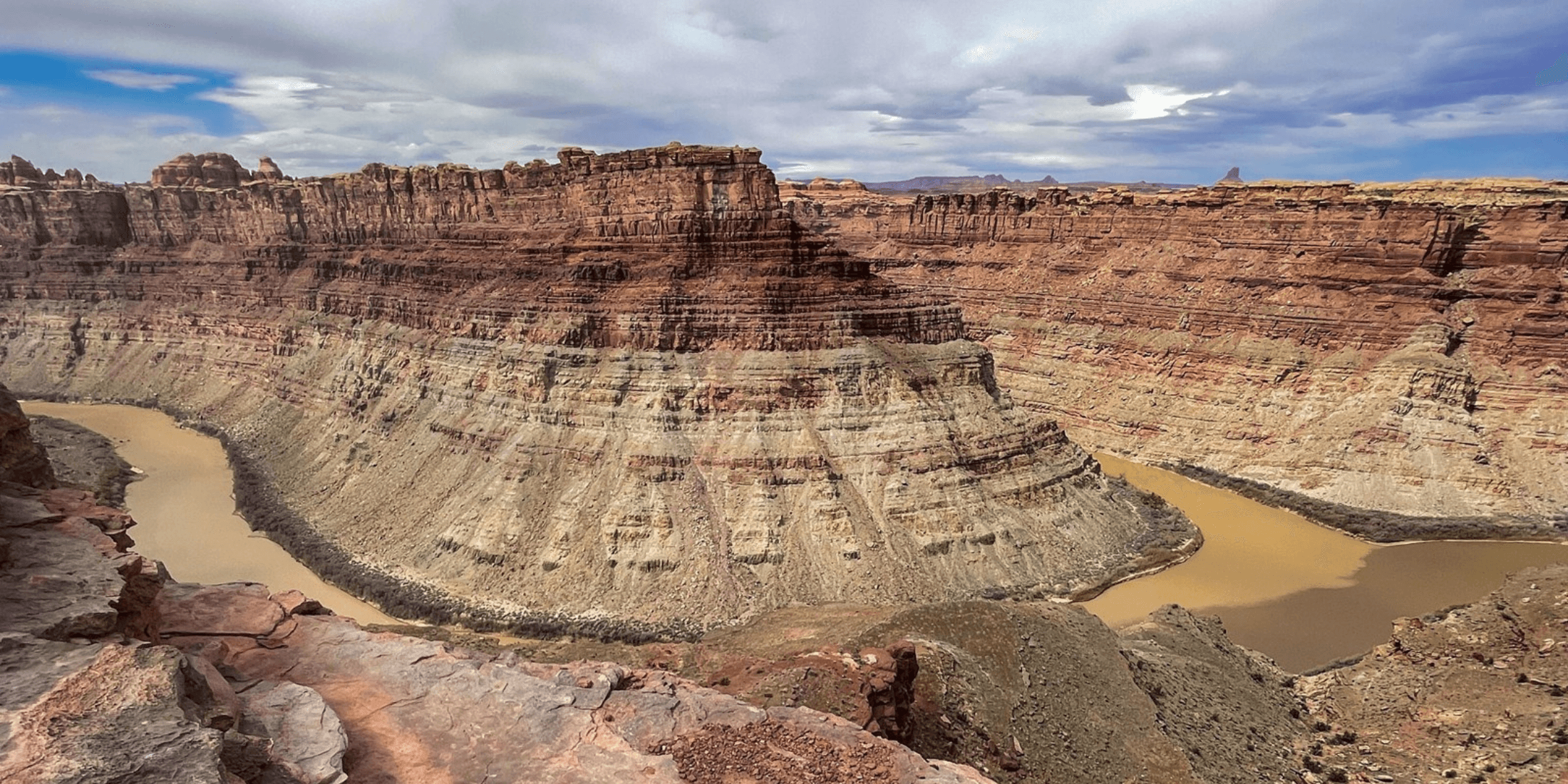
After 53 days on the river - tired and running low on food - the crew rounded a bend. July 16th, 1869. Day 53. The Green River flowed forward, and then, without any warning, another river pushed in from the right: the Colorado River.
A crew member named George Bradley wrote in his journal that day: "Hurrah, hurrah, hurrah!" Three exclamation points. He was so relieved to finally be there that he didn't even spell "hurrah" right.
Now here's the cool part. That man expected the two rivers crashing together to be dramatic and loud - like a roaring waterfall of water. But he wrote that the Colorado came in with a calm, strong tide, very different from what had been represented. Quiet. Steady. Almost gentle.
The Green River looks dark olive green because it drains from the high mountain snowfields in Wyoming - clean, cold, clear water. The Colorado looks red-brown, like chocolate milk, because it picks up red sediment - tiny ground-up bits of rock - as it flows through the red canyon country upstream.
Different rivers. Different sources. Different colors. And when they meet, for a while they don't mix. The two colors run side by side in the same channel, like two lanes on a road that happen to share the same pavement. You can actually see the line between them - one side green, one side red-brown, flowing together without blending. Eventually they do mix. But at the spot where they first meet - the confluence - you can see two rivers becoming one in slow motion.
Powell and his second-in-command hiked up to a high point above the rivers and looked out over what is now Canyonlands' most remote district - the Maze. Powell wrote that he saw "a world of grandeur spread before us." They rested for two days, took measurements, ate what food they had left, and then they got back in the boats. Because ahead of them was something that had no name yet - and it was loud.
Park Sound Game
Guess that park sound
A sound was recorded right here in Canyonlands National Park. What do you think was making it?
Ad Break[Advertisement spot - sponsor message goes here]
The Answer
A river otter. A river otter - in the desert. River otters actually live in the Green and Colorado Rivers right here in Canyonlands National Park - the same canyon rivers that Powell navigated in 1869. Most people don't even know they're there. River otters are incredible swimmers, and they love to play. They'll slide on mud and ice just because it's fun. Honestly, river otters might have more fun than almost any other animal out there. If you're ever floating on the Green River in Canyonlands and you hear a chattery, squeaky sound from the bank - now you know what it is.
Cataract Canyon
The loudest water in Utah
Powell named the calm stretch of water just above the confluence Stillwater Canyon - and it's a good name. Glassy, quiet, moving slowly through walls of rock that rise hundreds of feet on either side. But that calm had an ending.
Three miles below the confluence, the river changes - and it changes fast. Powell named this next section Cataract Canyon. A cataract is an old word for a waterfall or stretch of violent water - the kind that means hang on. In those three miles, the river drops and drops and drops. Thirty rapids, some of them plunging 30 feet in just a short stretch. At peak springtime flow, Cataract Canyon would fill 350,000 bathtubs every single second. It is the loudest water in Utah. You can hear it from over a mile away.
For Powell's crew, every single rapid meant the same thing: unload, carry, lower the boat, reload - over and over in 100-degree heat. They had to do that 30 times. And those rapids weren't random. Underneath this canyon, ancient salt has been slowly dissolving for millions of years, crumbling the walls from below - and that sends boulders into the river. Powell had no idea. He just knew he had to survive the water.
The crew was exhausted and running out of food. They had no idea how far civilization was. Three men, at the very end of the journey - just before the Grand Canyon - decided they couldn't continue and hiked out on their own. They were never seen again. The rest of the crew made it. And Powell emerged from the canyons and became famous overnight.
The maps he made - the first accurate ones of the entire region - changed how America understood its own land. Every trail sign in Canyonlands, every canyon name on the map, every district name the park uses: most of it came from one man in a wooden boat, with one arm and no map to start with. He made the map.
True or False
In Powell's honor: true or false?
True or false? Powell lost his right arm in the Civil War and then led the entire Canyon expedition with one arm.
True. He was hit by a bullet at the Battle of Shiloh when he was 27. His arm was amputated. He went back to the war - and then went on the most dangerous river expedition in American history. One arm.
True or false? The Colorado River, carrying all that red sediment, once built a delta where it emptied into the ocean roughly the size of Rhode Island.
False. The delta was real, but it wasn't the size of Rhode Island. It was the size of Connecticut - five times bigger. One river built a delta the size of an entire state.
True or false? The biggest rapids in Cataract Canyon are louder than a rock concert.
True. Rock concerts hit about 110 to 120 decibels. At peak spring runoff, the big drop is loud enough to hear from over a mile away. Standing next to those rapids, you'd have to shout to be heard - and Powell's crew had to work in that noise, portaging their boats around every single one.
Scout Question
Question of the DayJenni asked: If you could name a canyon of giant rapids and waterfalls, what would you name it?
Here's what some scouts had to say:
Listener Responses
Grant: "Grand Slam Canyon - because they slam together."
Sweet, age 6: "Dragon Falls."
Harper: "Russian Water Canyon."
If you want to send in a question for the show, ask a grown-up to help you visit the website and fill out the contact form. We love hearing from you.
What Did You Learn?
The Big Takeaway
Where the Green and Colorado Rivers meet inside Canyonlands, they actually run two different colors side by side - without mixing. Green from snowmelt, red-brown from canyon sediment. Two rivers, two colors, one channel - and a one-armed man in a wooden boat was the first person to tell the world about it. They do mix eventually, but for a good long stretch they run side by side. Many adults have no idea. Now you do.
Scout Mission
Your Mission
Explore and name your world
If you're at home, find a map - a map of your neighborhood or your town. Look at the names of the streets, the parks, the hills. Someone gave every single one of those places its name. Pick an area - like an empty lot, a field, or a river - and pretend it has never been explored. What would you name it?
If you make it to Canyonlands, head to the Island in the Sky district and find the Green River Overlook. It's a short, easy walk on a paved path. When you get to the edge, you'll be looking straight down at the Green River - the same river Powell and his crew rode for 53 days to reach the confluence. Try to find where it disappears around a bend. That's the direction he was heading. Somewhere down there, out of sight, is where it meets the Colorado.
Outro
Thank you for joining us today. John Wesley Powell looked at a blank map - the last blank space in America - and went for it. He came back with names for everything.
Next time we head back to Canyonlands, we're going to look at something so small you could step on it without even knowing it was there. Something with one of the most unbelievable survival stories in any national park. Tiny, ancient, and waiting for rain. Scouts, your next adventure is waiting.