Canyonlands National Park: A Crater, a Mesa, and a Mystery
Episode 013
17 minutes
Listen to this episode
Also available on:
Episode Description
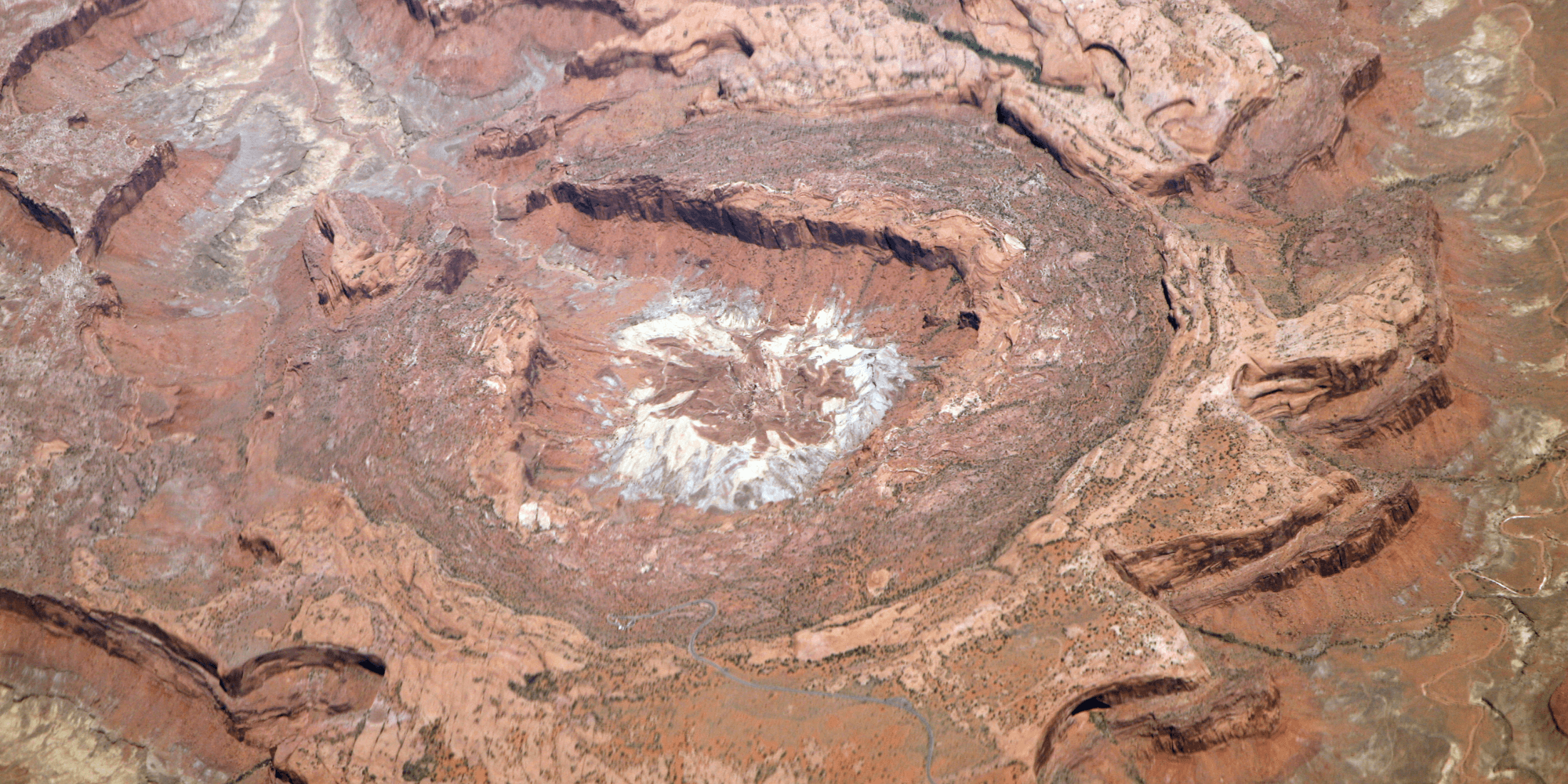
Meet Canyonlands National Park. First, we find out - what’s here? The Needles. The Maze. And of course, Islands in the Sky. Then we move on to an intriguing mystery. There’s a crater 3 miles wide. The rock layers are all over the place - but how did it get this way? Was it a meteor or a salt upwelling? Listen in and you decide.
Resources & Links
Never Miss an Episode
Get notified when we release new episodes
Join our community of nature lovers and curious kids!
Episode Transcript
National Park Scouts
Canyonlands: The Mystery of Upheaval Dome
Host: Jenni · Topic: Canyonlands National Park, geology, canyon tree frogs, Upheaval Dome
Intro
Right in the middle of the flattest, most perfectly layered rock landscape on the planet, there is a giant circle - almost a mile across. The rock inside it is twisted, crumpled, shoved in every direction at once. Everything around it? Flat. Perfectly flat. Four miles.
Scientists have been arguing about what made it for over 100 years. Was it a meteor? A rock from outer space that hit the earth at 40,000 miles per hour and blew a hole in Utah 60 million years ago? Or was it something underground - an ancient blob of salt left over from a sea that dried up 300 million years ago, slowly pushing up through the rock like a bubble rising through thick syrup.
Today, we're gonna look this mystery right in the face - and you get to make the call. Let's go!
Welcome to National Park Scouts, the show where curious kids discover America's wildest places. I'm Jenni. Today we're starting a brand new park, and this one is in a category all by itself. This park is not trying to be easy. It is, on purpose, one of the most raw, remote, and untamed places in the entire country.
Setting the Scene
Utah's Five National Parks
Utah is already famous for its national parks. You may have heard of Zion, with its towering red cliffs, or Bryce Canyon, full of orange spires called hoodoos. Arches, just up the road, with its famous red rock arches. Utah has five national parks total - people call them the Mighty Five.
Canyonlands is the biggest, the least visited, and the most remote of them all. It's the one that makes even experienced hikers and outdoors people stop and say - okay, this is serious. 527 square miles of canyon country carved by two rivers, divided into three completely separate worlds with no roads connecting them.
The Three Worlds of Canyonlands
Island in the Sky. A flat mesa - like a giant table made of rock - sitting 2,000 feet above the canyon floor. Paved roads, viewpoints, a visitor center. This is where most families go.
The Needles. Hundreds of red and white striped rock spires shooting straight up out of the ground. Hiking country. It's incredible.
The Maze. One of the most remote places in the entire country. No paved roads. Trails are unmarked. Rescues can take days. Even experienced explorers think twice. It is genuinely and intentionally wild.
Three worlds, no connecting roads, all of it carved by two rivers over millions of years. That's Canyonlands.
The Geology
Standing on the Edge
Imagine you're on top of Island in the Sky - that flat mesa. In front of you, the ground just stops. It drops straight down. 2,000 feet of canyon wall falling away below your feet. That's taller than the Empire State Building. Twice.
And those canyon walls? They're not just one color. They're striped. Red, orange, white, brown - layer after layer, stacked on top of each other like the world's biggest sandwich. Each one a different color because each one is made of different rock. Each one a different chapter in Earth's history.
The top layers are the youngest. The deeper you go, the older it gets. Way down at the bottom, the oldest rock visible was laid down when this entire place was covered by a warm, shallow sea. Utah - right in the middle of Utah - completely underwater, with ancient fish swimming around.
If you were here, you'd see a bright white stripe about a third of the way down the canyon wall, running as far as you can see in both directions. Scientists call it the White Rim Sandstone. 250 million years ago, that white layer was a sandy beach sitting at the edge of a warm ocean, right here in Utah. Everything in these canyon walls is older than the dinosaurs. Every single layer.
Guess That Park Sound
Here's a clue. It's an animal. It's very small. It lives in Canyonlands, and the place it lives would surprise you. Canyonlands gets less than 10 inches of rain per year - one of the driest places in the American Southwest. What kind of animal thrives in a place that dry? Listen, then take your best guess!
Ad Break
[Ad break placeholder - insert sponsor message here]
The Canyon Tree Frog
What was your guess? That sound is a canyon tree frog. Yes - a frog living in one of the driest canyons in North America.
Canyon tree frogs are pretty incredible. They spend most of their lives hiding in cracks in dry rock. Just waiting. No water, no swimming, no splashing around. They go into a kind of survival waiting mode. Then, when it rains - even just a little - they come out and sing their hearts out and find water wherever they can. Puddles in a rock. Little pools in low spots. Scientists call those pools potholes - which honestly sounds like a road problem, but in canyon country, it means a little pool that forms in a dip in the rock.
And here's the fun part. Canyon tree frogs have sticky toe pads - kind of like little suction cups. They can climb straight up a smooth rock wall in a desert where it almost never rains. That's a very determined frog.
Thank you to Michael Just for providing the park sound today. You can find more of his work at Dawntodawnphotography.com.
The Mystery
Upheaval Dome
Canyonlands has thousands of flat, perfectly layered rock strata - nice horizontal bands of different colors and ages, all stacked neatly on top of each other, like pancakes. For millions of years, layer after layer was laid down flat. And then in one spot, about three miles across, the pancakes go completely haywire.
Picture a giant blanket laid flat on the floor. Now imagine there's a bowl underneath the blanket right in the middle. You can imagine how the blanket rises up in a circle, peaks at the edges of the bowl, then dips back down toward the center. That's what Upheaval Dome looks like - except the blanket is solid rock, the bowl is three miles wide, and nobody can agree what made it.
From the air - or from the International Space Station, where NASA actually photographed it - it looks like a crater on the moon.
Theory 1 - Salt
Deep underground, underneath pretty much all of southeastern Utah, there's a massive layer of salt - left over from an ancient sea that dried up millions of years ago. When enough rock piles on top of it, the pressure makes the salt flow - not like water, but more like slow-motion toothpaste. Over millions of years, a blob of salt could push upward through the rock like a bubble rising through thick syrup, doming everything above it into that circular shape. Scientists think the salt bubble and all the rock above it has since been completely eroded away. What we see today is just the stem underneath - like finding the bottom of an ice cream cone after someone ate everything on top.
Theory 2 - Meteor
In 2008, German geologists studying rock samples from Upheaval Dome found something very specific: a mineral called shocked quartz. Shocked quartz can only form under one condition - extreme sudden pressure, the kind you get when a meteorite slams into Earth at tens of thousands of miles per hour. Regular geological processes, even volcanoes, cannot make shocked quartz. Only meteor impacts can. The theory is that about 60 million years ago, a meteorite roughly one-third of a mile across hit the earth right here, created a massive explosion, sent debris miles into the sky, and left a crater. 60 million years of erosion have worn away the surface and exposed the deep, twisted rock structure underneath.
The National Park Service says both theories are still on the table. Most planetary geologists - scientists who study craters on other planets - lean toward the meteor impact theory. But it hasn't been totally proven.
So what do you think, Scout? Salt moving underground for millions of years - or a space rock hitting the earth at 40,000 miles per hour? Hold that thought.
Wildcard - Who Would Win?
Who is better built for desert survival - a camel or a canyon tree frog?
The frog. A camel needs water every week. The canyon tree frog can wait out an entire dry season - sometimes longer - with no water at all. The camel is impressive. The frog is just ridiculous.
The White Rim Sandstone vs. the Grand Canyon - which one took longer to make?
The White Rim. It's not even close. The Grand Canyon is impressive, but it's basically brand new compared to a quarter-billion-year-old seafloor sitting right here in Utah. 250 million years ago, dinosaurs didn't even exist yet.
Scout Question of the Day
Scout Question
From Graham, age 8
"Why haven't scientists officially said it's a meteor crater? What would it take to prove it for sure?"
Great question - and here's the honest answer. Science doesn't work on one clue alone. Yes, shocked quartz is a major piece of evidence. It's the kind of evidence that really points toward a meteor impact. But scientists are careful. They want multiple lines of evidence all pointing to the same answer before they say something is definitely true.
The problem is that 60 million years of erosion has worn away a lot of that evidence. It's like trying to solve a puzzle when half the pieces have been swept away. Science works by accumulating evidence - like building a case in court. Right now, Upheaval Dome has enough evidence to make most geologists lean toward meteor impact. But the case isn't fully closed yet. And honestly, that's what makes it exciting.
Did You Know?
Inside Canyonlands National Park - an actual U.S. national park that anyone can visit - there is a section so remote that if something goes wrong and you need help, a rescue can take days. It's called the Maze, and it is one of the most genuinely wild places in the entire country.
Scout Mission
Your Mission
Make Your Own Crater
If you're at home: Go outside and find a patch of soft dirt, sand, or mud - somewhere you can make a mess. Find a rock, any rock. Drop it straight down from as high as you can. Look at what it leaves behind. See that little crater? See the way the dirt splashed outward in all directions? That's exactly what a meteor impact looks like - just scaled up a million times. Try it from different heights. Does a higher drop make a bigger crater? What happens with a really small rock versus a bigger one? You just did real impact science.
If you're visiting Canyonlands: Your mission is the Grand View Point Overlook. Find the White Rim - that bright white stripe in the canyon walls. You're looking at an ancient seafloor. Then drive to the Upheaval Dome overlook. Stand at the rim, look down into that circle, and make your call. Salt or meteor? There's no wrong answer yet. You're thinking like a scientist.
Outro
Next time, we follow two rivers to the heart of Canyonlands, where the Green and the Colorado meet. And we get to meet the man who first floated through these canyons in a wooden boat in 1869 - with absolutely no idea what was around the next bend.
Scouts, your next adventure is waiting.