Listen to this episode
Also available on:
Episode Description
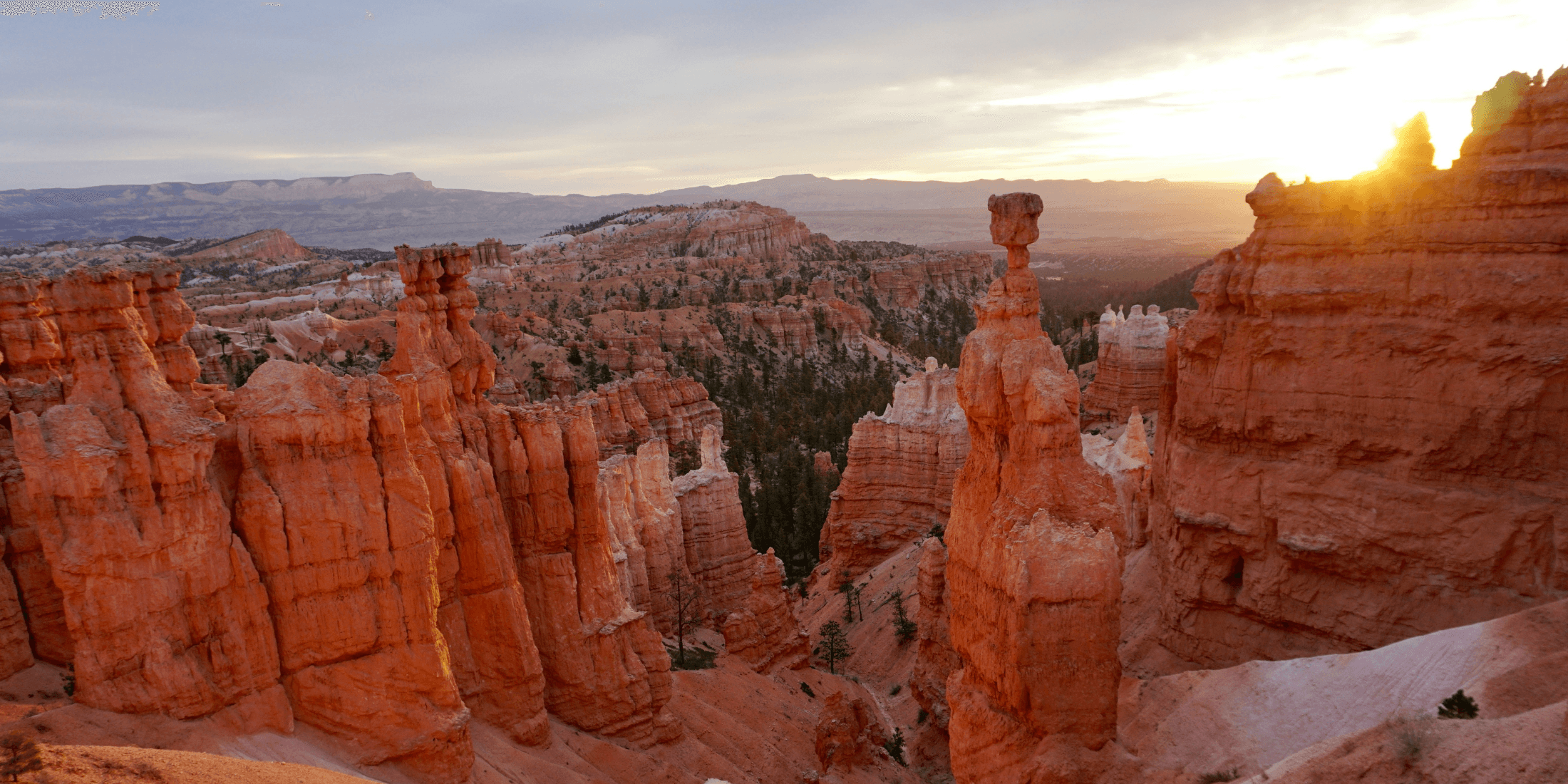
In the first episode of exploring Bryce Canyon National Park, we investigate the question, "why there are so many hoodoos here?" What is a hoodoo anyway? And why are they all colors of orange, red, and pink? Learn why elevation contributes to the "ice crowbar" that is working night and day in this awesome place. Discover the rusting effect and how the hoodoo's stone hats keep these giants standing for ages.
Resources & Links
Never Miss an Episode
Get notified when we release new episodes
Join our community of nature lovers and curious kids!
Episode Transcript
National Park Scouts
Bryce Canyon: The Hoodoos
Host: Jenni · Topic: Hoodoos, geology, ice wedging, Bryce Canyon National Park
Intro
Imagine you're standing in a forest. But the trees aren't trees. They're made of rock. Orange rock, pink rock. Some of them are taller than a five-story building. And some of them are wearing what looks like a stone hat. They're twisted and lumpy, and they go on as far as you can see in every direction. Thousands of them packed together like a crowd of giants that got stuck.
Welcome to Bryce Canyon, where nothing is quite what it looks like. It's not a canyon, and those aren't trees.
Welcome to National Park Scouts, the show where curious kids discover America's wildest places. I'm Jenni. And Scouts, today we're heading to southwestern Utah. High up on a plateau. To a place where the ground just drops away into a bowl of thousands of wild towering rock spires in every shade of orange, red, and pink you can imagine. This is our very first episode at Bryce Canyon National Park. And today we start with the thing that makes Bryce Canyon one of the most jaw-dropping places on the entire planet. The hoodoos. And by the end of this episode, you are going to know exactly what they are. Let's get into it.
The canyon that isn't a canyon
Okay, here's our first fun fact of the day, and I love this one. Bryce Canyon is not a canyon. I know the name says canyon, but technically - no canyon here. A canyon is carved by a river cutting down into rock over a long time. Like the Grand Canyon. The Colorado River did that. But at Bryce Canyon, there's no river doing that work. What we actually have is something called amphitheaters. These huge bowl-shaped hollows carved right into the edge of a plateau. The plateau is called the Ponsagant - that's a Paiute word meaning "home of the beaver."
The biggest bowl at Bryce is called Bryce Amphitheater. And it is 12 miles long, three miles wide, and 800 feet deep. That's about as deep as two and a half Statues of Liberty stacked on top of each other.
Fun Fact
So why is it called Bryce? Back in the 1870s, a Scottish settler named Ebenezer Bryce grazed his cattle here. People just started calling it Bryce's Canyon, and the name stuck.
And inside those giant bowls, there are thousands upon thousands of tall, skinny rock spires called hoodoos. That's a fun name, isn't it? Bryce has the highest concentration of hoodoos anywhere on Earth. Nowhere else on the planet has as many of them packed together as right here.
What is a hoodoo?
A hoodoo is a tall, skinny rock spire - kind of like a tower. And a lot of them have a big rock balanced on top, almost like they're wearing a stone hat. Some look like people, some look like animals, some look just completely bizarre - like nothing you've ever seen.
They're made from a type of rock called the Claron Formation, a mix of stones that used to be the bottom of a huge freshwater lake that sat here about 50 to 60 million years ago. That lake dried up, the sediment turned to rock, and the whole plateau got pushed up higher and higher by forces deep inside Earth.
Why are they orange?
The rock at Bryce is loaded with iron. And iron, when it sits in the air and gets wet, it rusts. The pink, orange, and red colors are basically the whole park being one giant rust experiment. Iron plus air plus water equals hoodoos that look like they're on fire.
How the hoodoos are born
It starts with ice. Bryce Canyon sits up high - over 9,000 feet above sea level. At that elevation, temperatures go above and below freezing almost 200 nights a year. That means during the day, snow melts or rain falls, and that water seeps into tiny cracks in the rock. Then at night, when temperatures drop below freezing, that water freezes.
Here's the key thing to remember: when water freezes, it expands. It gets about 9% bigger. Imagine a tiny crowbar made of ice, wedged inside a crack in the rock. Night after night, 200 nights a year, it pushes and pushes, slowly prying the rock apart, chunk by chunk. Scientists call this ice wedging. Over a very long time, those cracks become walls, and those walls get thinner and thinner, and eventually they break apart into individual spires. That's when the hoodoo is born.
But here is why hoodoos end up tall and skinny with a rock hat on top. Some layers of rock are harder than others. The softer rock wears away faster, but the hard rock on top - that's a type called dolomite. It erodes much more slowly. It acts like a hard hat, protecting everything underneath it. So the soft rock below wears away while the hard cap on top hangs on, leaving this tall, skinny spire with a boulder balanced on top.
Hoodoos range from about five feet tall to over 150 feet tall. The tallest ones are taller than a 15-story building.
Guess that park sound
Alright, Scouts - we're gonna leave the hoodoos for a minute because it's time for "Guess That Park Sound." I'm gonna play you a sound from Bryce Canyon. What do you think is making that sound? Hold on to your answer; we'll find out right after this.
Ad Break
[Ad break placeholder - insert sponsor message here]
Okay - you heard a coyote. And coyotes are all over the American West. Here's what makes them cool. Coyotes are incredibly smart hunters. And at Bryce Canyon, they have a favorite meal: prairie dogs. But the prairie dogs know it. They post lookouts and let everyone know if they see a coyote coming. In our next episode, we're going underground to meet the prairie dogs of Bryce Canyon. And they are cooler than you think.
Visiting Bryce Canyon
Scouts, here's something I love about Bryce Canyon. It is one of the smaller national parks. It's actually smaller than 50 of the other 62 national parks in the country. And that means you can have a genuinely amazing visit in just a day or two without rushing. There's an 18-mile road called the Rim Road that connects all the major viewpoints. If hiking isn't in the plan for your family - no problem. You can see jaw-dropping hoodoos from the car.
Spots you don't want to miss
Sunset Point. This is where you'll meet the most famous hoodoo in the whole park - a spire called Thor's Hammer. It is about 150 feet tall, and it really does look like a giant hammer balanced on a skinny handle. You can see it right from the overlook. No hike required.
Wall Street. This is a trail that takes you down into the amphitheater. And when you get in there, you're walking between walls of hoodoos on both sides. They tower above you.
Natural Bridge. About halfway down the scenic drive, there's a pullout where you can look down and see a massive natural stone arch. It's made of the exact same Claron Formation rock as the hoodoos - it just eroded in a completely different shape. Same rock, same rain, same ice, but totally different result.
Tip: consider winter
Summer means ranger programs, astronomy nights, and great weather. But winter at Bryce is something else. Snow settles on top of the orange hoodoos and it looks almost unreal - orange and white in every direction, and there's almost nobody there.
Named hoodoos
People have been looking at the hoodoos and seeing shapes for a long time. Rangers and visitors have given some of them names. You've already met Thor's Hammer. There's one called Queen Victoria, in an area called the Queen's Garden - if you look at her from the right angle, she really does look like the Queen herself, crown and all. There's the Silent City, a section of amphitheater where hoodoos are packed so tight they look like a skyline of skyscrapers. There's also the Tower Bridge, which looks almost exactly like the famous bridge in London. And there's one called the Poodle - though honestly, erosion has been working on the poodle for a while now, and it's looking a little less poodle-ish than it used to.
When you visit, look at the hoodoos and ask yourself: what do you see? Because there are thousands of them out there with no names yet, waiting for someone to look at them the right way.
Wildcard round
Does the Clark's Nutcracker or the elephant have a better memory?
The answer is the bird - and it's not even a close contest. Every fall, a Clark's Nutcracker buries somewhere between 22,000 and 33,000 pine seeds across thousands of different hiding spots spread over many miles, then finds them months later - sometimes nine months later - to eat. Elephants have legendary memories too, but in a pure contest for remembering hidden locations, the nutcracker wins. We're going to meet this bird up close in a future episode, and it has one of the most important jobs in the entire forest.
Which is colder: your freezer at home, or Bryce Canyon in winter?
Bryce Canyon wins by a lot. Winter temperatures at Bryce can drop to -30 degrees Fahrenheit. Your freezer sits at zero degrees. Bryce Canyon is 30 degrees colder than your freezer. And that, Scouts, is exactly why the ice wedging trick works so well here. Those extreme temperatures, swinging from warm days to brutally cold nights, are happening 200 times a year. More swings, more ice crowbars, more hoodoos. It's not an accident that the hoodoo capital of Earth is also one of the coldest spots in Utah.
Scout question of the day
Scout Question
From Elizabeth, age 8
"Do these tall hoodoos ever fall down? What happens then?"
Oh yes. Yes, they do. There was a hoodoo at Bryce called the Sentinel. It stood right along the Navajo Loop Trail, not far from Thor's Hammer. It was tall and skinny and tapered down to a waist that was only about two feet wide at the bottom. Visitors would walk past it for years, wondering when it would finally fall. In November of 2016, it did - overnight, while nobody was watching, the top 15 feet came down. The ice crowbar had been working on that two-foot waist for years, and one night it finally won. But it's not a sad ending. The same ice that eventually knocks a hoodoo down is quietly carving new ones right now. Tonight, while we're talking. The Sentinel is gone, but somewhere in those limestone walls, a new one is already on its way.
Scout mission
Your mission
If you're at home, find something rusty. A nail, a bike chain, a hinge - anything that's turned orange or brown. Take a good look at it. That reddish color is iron oxide, the same chemistry that's making the hoodoos orange right now, thousands of miles away in Utah. You're looking at the same science, just on a much smaller scale.
If you're visiting Bryce Canyon, there are hidden markers called "Hike the Hoodoos" tucked along the trails. There are nine of them total, spread across eight trails. Find three of them - use paper and a crayon to get a rubbing, or take a photo and bring them to the visitor center - and you'll earn a reward. If you want the full challenge, find all nine.
Outro
That's it for today, Scouts. Bryce Canyon is one of those places that looks like someone made it up. But it's real. It's out there right now, and you know exactly how it got that way. The hoodoos at Bryce aren't finished. They're still being carved right now - one freezing night at a time.
Next time, we're going underground - into the dark, into tunnels - and we're meeting the surprisingly noisy residents that live below the surface of Bryce Canyon. Scouts, your next adventure is waiting.