Also available on:
Episode Description
Built like a fighter jet, this bird of prey is faster than anything else on Earth. Faster than Formula 1 cars, faster than sky divers, nothing can compare to the predator of the sky - the Peregrine Falcon. In this episode, we join this bird on the cliffs and uncover the superpowers that keep this bird alive at 242 miles per hour. Learn how an invisible chemical threat called DDT caused these amazing birds to completely disappear from the eastern United States and the genius plan biologists used to bring them back.
Parents & Educators: This episode is perfect for kids ages 6–12 and covers key STEM concepts including food chains, animal adaptations, and environmental conservation.
Resources & Links
Never Miss an Episode
Get notified when we release new episodes
Join our community of nature lovers and curious kids!
Episode Transcript
National Park Scouts
The Fastest Animal on Earth
Host: Jenni·Park: Acadia National Park·Topic: Peregrine falcon - speed, biology, recovery
Intro
That was a Formula One race car. One of the fastest machines ever built by humans. Top speed? Around 230 miles per hour. Pretty fast, right? But there is an animal on this earth that is faster than that. It doesn't have an engine. It doesn't have fuel. It has feathers.
It has been clocked at over 240 miles per hour - faster than a race car at full speed, faster than a skydiver falling through the sky, faster than anything else alive on this planet. And it lives at one of the most beautiful national parks on the entire East Coast. In fact, it lives in almost every one of America's 63 national parks. Can you guess what it is?
Let's go find out. I'm Jenni, and today we are exploring a new park: Acadia.
Acadia National Park sits on the coast of Maine - that's way up in the northeast corner of the United States. The park is mostly on an island called Mount Desert Island, and it has something you don't find at a lot of other parks: mountains that drop straight into the Atlantic Ocean. It is one of the most visited national parks in the United States, and once you see it, you can understand why.
Today, our first episode at Acadia. We are covering the fastest animal on Earth - the Peregrine Falcon. We're going to find out how it goes 240 miles per hour, how it stays alive when it hits that speed, and the incredible story of how it almost disappeared and then came back. Let's talk about this bird.
The Peregrine Falcon
A bird built like a fighter jet
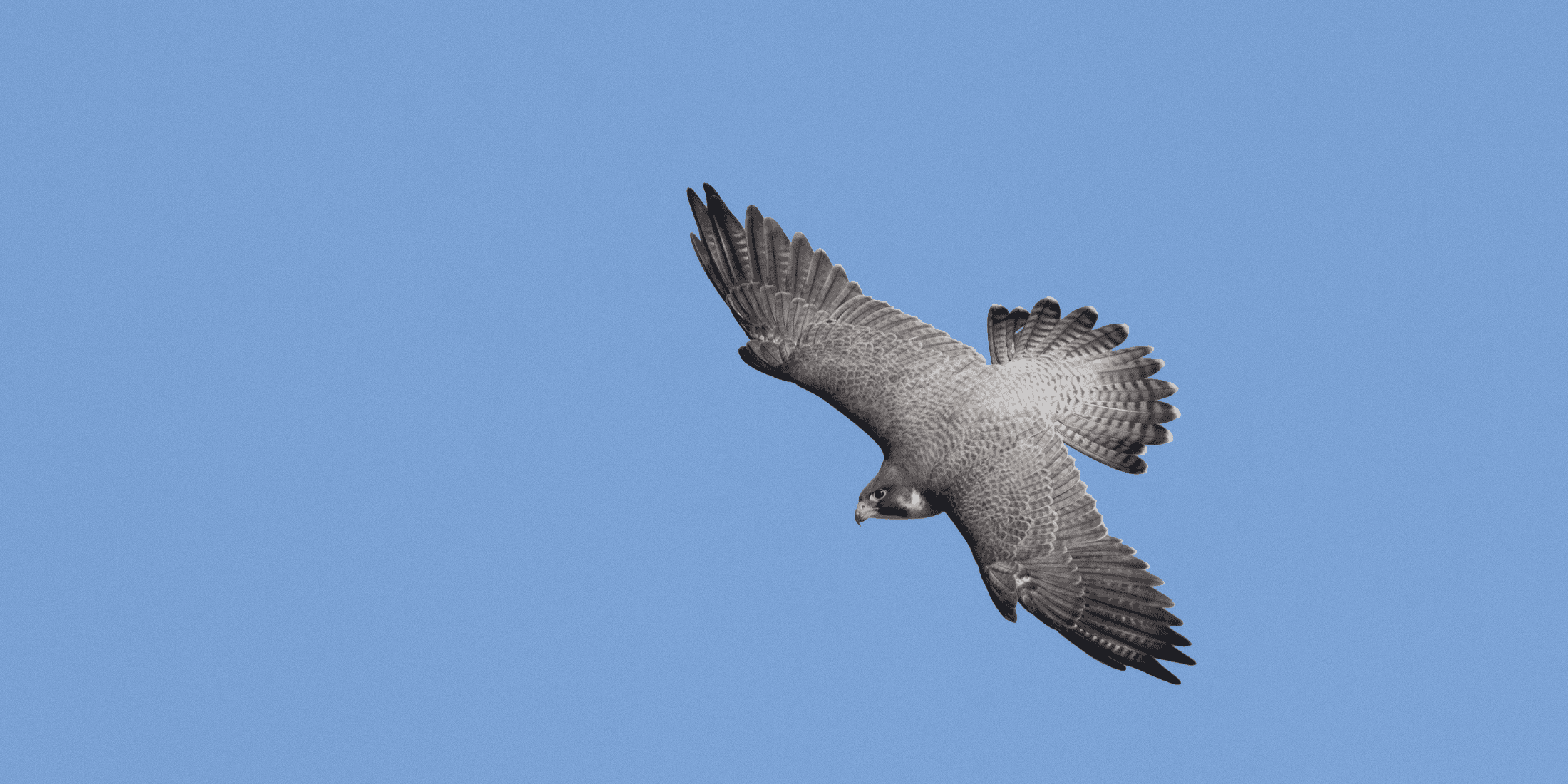
A peregrine falcon is roughly the size of a crow - not huge. It has a bluish-gray back, a creamy white chest, and its head looks like it has a painted-on helmet. But this bird is built like a fighter jet.
The peregrine is a hunter. It eats other birds - pigeons, ducks, shorebirds - and the way it hunts is remarkable. It finds a high place, a cliff, a mountaintop, and it watches. When it spots its target way down below, it doesn't just fly after it. It dives. Scientists call this the stoop.
The peregrine pulls its wings back tight against its body, tucks everything in to create a narrow teardrop shape, and drops - using gravity, straight down, picking up speed the whole way. The record speed is 242 miles per hour. Faster than a Formula One race car, faster than a skydiver, faster than anything else alive on this earth.
How it survives that speed
Here's the question that should be in your brain right now: how does it survive that speed? If you were to go that fast, the air pressure rushing at your face would hurt. It would damage your lungs. For most animals, 242 miles per hour means death. But the peregrine falcon has answers for all of that - and they are incredible.
Adaptation - Tubercles
Inside its nostrils, tiny bony bumps called tubercles act like a redirector. They force the air rushing in to spiral around instead of slamming straight into the lungs. Without them, the air pressure at that speed would rupture the bird's lungs.
Adaptation - Third Eyelid
Its eyes have a nictitating membrane - a third eyelid that slides sideways across the eyeball as the bird hits full speed. Like a pair of built-in goggles that the falcon can close without actually losing vision.
Adaptation - Strike
When the peregrine hits its prey, it strikes with a closed fist of talons - a devastating blow delivered at the end of a full-speed dive. This bird is a flying machine, and every part of it is exactly right for going impossibly fast.
Park Sound
Guess That Park Sound
Okay, scouts - what was that? Some kind of angry squirrel? A very upset parrot? Maybe a different type of animal entirely? Take your best guess. We'll come back to it right after the break.
Ad Break
[Ad copy not provided - placeholder for sponsor message]
Sound Reveal
That was a peregrine falcon - the fastest animal on earth, the world record speed holder. It sounds like it's complaining about something. That call is the alarm call; the sound they make when they're defending their territory or telling intruders to back off. Rangers at Acadia actually use that call to know when a falcon has spotted something it doesn't like - including occasionally a hiker who got a little too close to its nesting cliff.
The Disappearance
How the fastest animal on Earth almost vanished
After World War II, scientists invented a powerful pesticide - a chemical that kills insects - called DDT. They sprayed it on farms, in forests, and in neighborhoods to kill mosquitoes. It seemed like a miracle. But here's the problem: DDT didn't stay put.
Rain washed it into streams and rivers. Fish absorbed it from the water - and the peregrine falcon eats birds, and those birds eat fish and bugs. So the DDT traveled up the food chain from the stream to the fish, to the small birds, to the peregrine. Each step up the food chain, the DDT got more concentrated. Scientists call this biomagnification - bio means life, magnification means making something bigger. By the time it reached a falcon at the very top, it was highly concentrated in their bodies.
The sneaky part
DDT didn't kill the adult falcons outright. Instead, it made their eggshells so thin that when a parent sat down to keep the egg warm - normal, everyday parent-bird behavior - the egg would crack under their weight. The chemical interfered with the way the mother birds produced calcium; the stuff that makes bones and eggshells hard. Without enough calcium, the shells became thin as tissue paper, and no eggs hatched.
By the 1960s, peregrine falcons had vanished from the entire eastern United States. Right here at Acadia National Park on Mount Desert Island, the last known nesting pair was recorded in 1956. Then nothing. For decades, not a single peregrine chick was born here.
The fastest animal on earth wasn't beaten by something faster. It was beaten by something it couldn't even see.
The Comeback
Hacking - how scientists brought falcons back
Peregrine falcons don't just wander back on their own. They need a cliff that feels like home. So scientists came up with a plan called hacking. They hatched peregrine chicks safely in a lab. Then, when the chicks were just a few weeks old and still fuzzy, scientists carried them up to the highest cliffs in Acadia and placed them in special wooden boxes.
The scientists fed them every day - but they had to be sneaky. They delivered food through a long tube, so the chicks never saw a human. The goal was to trick the chicks into believing that specific cliff was their real home. Scientists called this imprinting.
Did it work? Yes. Acadia joined the program in 1984, releasing 22 chicks over a few years. By 1991, the first wild peregrine chicks in 35 years were born on the cliffs of Acadia. Since then, more than 160 chicks have taken flight from the park's cliffs. And in 1999, the peregrine falcon was officially removed from the endangered species list.
Ad Break
Hit that subscribe button right now and leave us a five-star review. It takes a few seconds, but it's the absolute best way to help other people find the podcast.
Wildcard
True or False
True or false: a peregrine falcon can dive faster than a Formula One race car at full speed.
True. The fastest recorded peregrine dive is 242 miles per hour. A Formula One race car tops out at around 230. The bird wins.
True or false: peregrine falcons build big stick nests like eagles and ospreys.
False. Peregrine falcons don't build nests at all. The fastest bird on earth raises its babies on a bare rock ledge - no sticks, no grass, no leaves, no anything. Just a little dent scratched into a cliff. Scientists call it a scrape. That's the actual name. A scrape. Somehow, that's enough.
True or false: the peregrine falcon has a third eyelid.
True. The nictitating membrane - that clear, see-through third eyelid - slides sideways across the eye at a full-speed dive. The falcon can close it completely and still see perfectly. It's so cool it honestly seems made up.
True or false: peregrine falcons at Acadia never leave their home.
False. The peregrines at Acadia migrate south for the winter. In fact, peregrine falcons can migrate up to 25,000 miles on their trip to Central or South America - making them the farthest-migrating bird of prey. But peregrines that live in temperate climates with plenty of food year-round might not migrate at all.
Scout Question
Scout Question of the Day
If you could name the next peregrine falcon chick, what would you name it?
Henley, age 9
I would name it Peregriel.
Oshan, age 9
I would like to name the new peregrine falcon baby Jerry Jr. - because my dog's name is Jerry and he is very fast.
Do you have a question about a national park, or do you want to be on this podcast and answer one of our questions? Visit our website, NationalParkScouts.com/contact and tell me. While you're there, check out our coloring pages, word searches, and bingo cards.
What Did You Learn
What did you learn today that most adults don't know?
The fastest animal on Earth has little bony bumps that spiral the incoming air so its lungs don't explode. Nature thought of that before we did. The inlet cones on supersonic jet engines are the same basic idea - inspired by a bird.
Scout Mission
Your Mission
If you're at home: go outside and measure out 100 feet - that's about the length of three school buses parked bumper to bumper. Have a parent or friend time you running that distance as fast as you can. Write down your time.
Here's the math: at 242 miles per hour, a peregrine falcon covers that same 100 feet in less than half a second. Faster than you can blink your eyes twice.
If you're visiting Acadia: go to the base of the Precipice Trail. The trail will likely be closed in spring and early summer - and now you know why. Look up at the cliff face and wait. If a peregrine is nesting up there, you might see it perched on a ledge, or hear that loud alarm call. Bring binoculars if you have them.
Somewhere on that cliff there might be a fuzzy white chick that will one day be the fastest animal on earth.
Outro
We have barely scratched the surface of this park. Next time, we are heading up into the pink granite mountain - where a hundred-ton boulder has been sitting on the edge of a cliff since the last ice age. It looks like it's one bad day away from tumbling into the valley. We're going to find out exactly how it got there, and why it stays. And we're going to do it at sunrise.
Because Acadia sits on the highest peaks of the eastern seaboard - that means on a clear morning, this is the first place in the entire country to see the sun come up.
Scouts, your next adventure is waiting.